
MTN lawyers say AGF’s legal arguments unacceptable and unknown to law

MTN lawyers say AGF’s legal arguments unacceptable and unknown to law

Fireworks
continued today as MTN Nigeria and the Attorney General of the Federation and
Minister for Justice continued their legal battle over the appropriateness of
the latter’s demand for $2 billion in back taxes. While MTN maintained that the
AGF was beyond his remit, the AGF sought to justify his demands.

At a
hearing in the Federal High Court in Ikoyi, Justice C J Aneke heard arguments
relating to the substance of the AGF’s preliminary objection (from November
2018), the detail of which was only filed in court by the Attorney General late
on March 25
th, and which has yet to be served on MTN. The arguments did
not focus on the substance of MTN’s suit, as the AGF’s preliminary objection
that MTN did not commence legal proceedings within 3 months of the cause of
action arising must first be addressed.

MTN’s
team of lawyers led by Chief Wole Olanipekun maintained that the AGF’s
contentions were unacceptable and unknown to law. They argued that the cause of
action actually crystalised when the AGF made a demand of MTN and threatened
the company with court action on August 20th. Previous correspondence from the
AGF was acted upon in good faith by the company, he continued. He revealed that
the previous correspondence had requested a self-assessment.

He
posited that the organization not only undertook the self-assessment but went
ahead to submit the result of that process to the AGF’s office. The assessment
was undertaken by KPMG and showed clearly that no back taxes were owed to the
Country. Despite this, the letter of August was still written. That letter
heightened issues and led to the company seeking to protect itself from the unlawful
actions of the AGF.

The
learned SAN further argued that to the extent that the letter has not been
withdrawn, the cause of action continues to exist. Therefore MTN remains within
its rights to approach the courts. Counsel to AGF was asked directly whether
the cause of action had been withdrawn (and so the demand itself withdrawn) but
declined to respond.  

The
Chief further posited that from the AGF’s pleadings his office had admitted the
submission of MTN in so far as his main argument is not in response to the core
issues raised by MTN, but to whether or not the AGF is protected in law from
the consequences of his actions. The Chief argued that it is implicit in the
AGF’s failure to address the substance of MTN’s case, that the AGF is aware it does
not have the legal authority to take the action it has taken.

Justice Aneke, after hearing the submissions of learned
counsel to both parties, reserved ruling on the preliminary objection until May
7th.

MTN Nigeria instituted the suit by a writ dated September
10, challenging the legality of the AGF’s assessment of its import duties,
withholding of tax and value-added tax in the sums of N242 billion and 1.3
billion dollars. In the suit, MTN claims that a revenue assets investigation
allegedly carried out by the Federal Government on MTN over the period from
2007–2017 violates Section 36 of the Constitution of the Federal Republic of
Nigeria. It also claims that the government’s August 20 letter stating the tax
demand to the company contravenes the provisions of the section.

The telecoms company seeks a declaration that the defendant
(AGF) acted in excess of his powers by demanding an assessment, which MTN
claims, usurped the powers of the Nigerian Customs Service to demand import
duties and the powers of the Federal Inland Revenue Service to audit and demand
remittance of withholding tax and value-added tax.

Over-reach
by the AGF has been a consistent theme recently, with President Muhammadu
Buhari already having ordered him to terminate a separate agreement through
which he sought to collect supposedly ‘additional recoverable revenue’ from the
International Oil Companies.

Legal effects of Condonation in Employment Relations | Michael Dugeri

Legal effects of Condonation in Employment Relations | Michael Dugeri

Condonation means the
forgiveness, purposeful disregard, or tacit approval by a victim of another’s
illegal or objectionable act, especially by treating the other person as if nothing
happened.

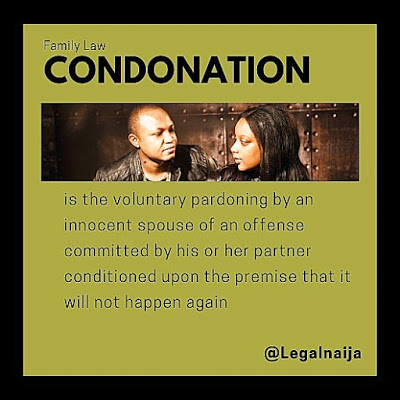
In law, the term condonation is more commonly associated with
matrimonial proceedings, in which case it is understood as the voluntary
pardoning by an innocent spouse of an offense committed by his or her partner
conditioned upon the premise that it will not happen again. Condonation, which
is used as a defence in divorce actions based on fault grounds, is strongly
supported by public policy. The institution of marriage and its preservation
are considered essential for the stability of society, and therefore
condonation is encouraged to promote the notion that marriages should not be
dissolved easily. 

Employment relations have been likened to marriages, for a number of
reasons. It is often said that
successful
labour relations are more like ‘a marriage, not a boxing match’. It is expected
therefore that both parties will sometimes have to overlook certain infractions
from the other in the interest of the relationship. However, what happens if
the forgiving party later regrets the decision to forgive and decides to
enforce their rights against the forgiven party in respect of the forgiven
offence? Are they allowed to do so and within what timeframe? What in fact,
constitutes condonation in employment relations?   

The answers to these questions will usually depend on the
context. Hence, the answers will be provided by examining a few decided court
cases on the issue of condonation in employment relations. To begin with,
condonation may either be by the employer or employee; it may also be express
or implied. Where condonation is express, the offended party expressly waives
his right to sue or complain, by stating so in writing or where the timeframe
to react to the offence, as provided by law or contract, has elapsed.. In cases
like these, there is little difficulty in establishing condonation. The
situation is however nuanced in cases where condonation is implied. That is,
where the offended party seems to have forgiven or overlooked the
offence/breach but without actually doing so.

In anticipation of situations of
implied condonation, some employment contracts (like most other commercial
contracts) contain a “no waiver”
clause, which typically provide that delays do not adversely affect the rights
of a party to enforce the terms of the contract.However, is the offending party
allowed to simply move on with the relationship without knowing whether or not
his breach may be relied upon at some point in future to apply disciplinary
measures like suspension or even termination? On the other hand, when a party
to a contract waives
breach of that contract by the other party, it
voluntarily abandons its legal rights to enforce the contract, or to claim any remedy, in
relation to that breach.
waiver must be
clear, but may be oral or written.

Another major consideration in determining
condonation is if the offended party intends to seek remedy outside the
workplace, like suing to enforce its rights or demand damages. In such a case,
one needs be mindful of “
Limitation
Law”, that is, the law that a suit must be commenced within a specific period
of time from when the injury or omission, causing the damage or loss, arose or
occurred. Grievances need to be settled in time while the evidence in support
of the claim, or the defence to a claim, is/are still fresh. Not commencing
legal action within the statutorily specified period extinguishes the right to
seek remedy. Employment contracts are classed as simple contracts. Legal
actions based on simple contracts (like recovery of debts and arrears of
interest, tortuous malfeasance which includes damages for negligence or breach
of a duty of care, account stated, etc.) must be commenced within a period of
six (6) years of the occurrence of the injury, loss or damage.

However, if the available remedy is internal, like an
employer subjecting an erring employee to its disciplinary procedure,
condonation will be implied if remedy is not sought nor applied within the
period specified for it under the employment contract or the company handbook.
Where the contract or the company handbookare silent on the period of
disciplinary proceedings, a reasonable time will be applied in determining
whether or not the employer can be said to have condoned the infraction in
question.

A key principle in industrial relations law and practice is
that the disciplinary process must not run slowly and sluggishly, or be
unnecessarily prolonged; for otherwise, the employer stands the risk of being
subsequently barred from applying penalty. From this principle, two rules are
evident: firstly, the right to suspend an employee available to an employer is
not a right that is eternally available. And secondly, where there is an
infraction, an employer who allows the disciplinary process to run very slowly
and sluggishly stands the risk of being read to have condoned the said
infraction. As a result, courts customarily frown on a prolonged suspension,
and in some cases, quash the suspension.

In one of the decided cases,the Court expressed its
displeasure over a prolonged suspension, when the employee in question had been
suspended for a period of over 18 years. The suspension was held to be unfair
and unjust and accordingly quashed. In another case, the claimant was
erroneously suspended in 2005, recalled in 2009 and told that he will still be
investigated for what he was initially and erroneously suspended for. The Court
in this case also set aside the suspension and ordered that employee be paid
all his entitlements without any loss of benefit including arrears of his
salaries.

In yet another case, the employee sued to contend his
employer’s act of summary dismissal was irregular in the sense that the employerafter
the conclusion of the investigation did not suspend, terminate, sanction or
summarily dismiss him. Rather, the employer transferred him to a different
branch as its employee to continue on the job.The employer was held to have
condoned the infractions, which he later purported to act upon in dismissing
the employee. 

The court has also held that in a case where the staff handbook
provided that ‘disciplinary proceedings for any misconduct shall be dealt with
as soon as possible’, undue delay on the part of the employer must be read as a
waiver of the right of dismissal, and that any dismissal afterwards can only be
construed as a case of victimization.

The common principle in all these cases is that where an aggrieved
party is lax in seeking remedy (and the laxity is usually for a period exceeding
one year),condonation will be implied. This means the aggrieved party must be
decisive in considering legal action in deserving cases. This is especially for
the employer, who is often required to apply disciplinary measures. When the
disciplinary process is activated, it is essential to follow the process
through completely. Employers must have robust procedures and supporting
documentation in place to effectively discipline their employees, both to
ensure procedural fairness, and to protect their position, should the employee
take action against them.

In practice, the disciplinary process starts well-invitation
to the meeting is sent, the meeting is held, all the evidence and the employee’s
response is considered, the decision is made to apply the penalty, the employee
is advised that they are getting a punishment, but then the letter never gets
issued. Often these matters are not followed up because of the difficulty of
articulating the problems, creating performance improvement plans and setting
quantifiable outcomes. Subsequently, the whole grievous process achieved so far
will be wasted.

In
conclusion, it is important to note that disciplinary procedures in the workplace
will be to the benefit of both the employer and the employee. Employers often
find themselves making costly procedural mistakes when disciplining or
dismissing an employee for misconduct. They may have a fair reason for
dismissal, for example the employee has stolen company goods, deliberately
damaged the employer’s property or breached health and safety rules, but if the
employer has not followed a fair procedure, this can make the whole process
unfair.

Having a
clear, legally compliant and well-written procedure will guide an employer
through a good disciplinary procedure which will reduce the likelihood of
running into legal action and providing the affected employee with the much
needed feeling of fairness of the process.

Micheal Dugeri

Corporate Commercial Lawyer at Austen-Peters & Co.

Membership Rights Of A Company | Blessing C. Madu

Membership Rights Of A Company | Blessing C. Madu

A Business can attract
investors other than the business owner. A major way for the investor to
participate in these businesses is to invest in the company by purchasing
shares. Anyone who purchases shares is called a shareholder. Shareholders are
very important persons in a company whether it is public or a private limited
company. A shareholder is one who owns at least one share, attracting at least
one vote in a company. A subscriber of shares is not regarded as a shareholder
until shares are actually allotted to him. There is equally a very important
person in a company. They are referred to as the Members of a company.

A member of a company is a
person having constituent proprietary interest in the company and whose name
has been entered in the Register of Members. The right of members is dependent
upon the Companies and Allied Matters
Act Cap C20 LFN 2004
, Articles of Association and any agreement entered
into by a member.

In the ordinary commercial
language, the term “Member’’ denotes a person who holds shares in a company. Members
and Shareholders are often  used
interchangeably. It is pertinent to note that there is a difference between a
shareholder and a member of a company although the difference is not too
visible. A member is one who satisfies the provision of Section 79 of CAMA. This
Section provides that a member of a company is one who agrees to become a
member and whose name is entered in its register of members. The original
subscribers to a company memorandum are considered to have agreed to become a
member of a company. Thus, membership of a company is not synonymous to
shareholding.

Differences
between Members and Shareholders

The following are the
differences between members and shareholders:

·       
A shareholder will not become a member of a
company until his name has been input in the register of members. A shareholder
is a person who owns the shares of the company.

·       
All shareholders whose names are entered in
the register of members are the members. Thus, all members may not be
shareholders.

·       
Proof of shareholdership is by a share
certificate; while proof of membership is by the register of members. Ponmile
v Sparks Electrics Nig. Ltd (1986) 2 NWLR 519 AND Oilsfield Supply Center Ltd
v. Johnson (1987) 2 NWLR 625.

For a person to be a member
of a company, he must

·       
Subscribe to shares, that is, he must be
allotted at least a share in the capital of the company

·       
Consent to be a member

·       
Enter his name in the register of members
before he enjoys membership benefits

If any of these conditions
is not satisfied, the person shall not be a member under this Act.

Membership of a company can
be acquired through any of the following ways;

·       
By subscribing to the Memorandum before the
registration of the company.  Section
79 of CAMA
.

·       
By applying for the shares offered by the
company. Section 125 of CAMA.

·       
By becoming a transferee of a share and being
placed in the register of members. Section 151 of CAMA

·       
By transmission of shares on succession to a
deceased or bankrupt member and the consequent registration in the register of
members. Section 155 of CAMA

·       
By share qualification: the Articles may
require a director of a company to take up shares in the company upon his
appointment.

The entry in the Register of
members is an indispensable condition for membership. Berliet Nigeria Co. Ltd v.
Francis (1987) 2 NWLR 675.

Every Nigerian company acts
through its member or shareholders either in its general meeting or through the
Board (these are the main organs of a company). The importance of having a
member and a shareholder or both cannot be over emphasized. A business owner
cannot grow a company singlehandedly.  He
is like a coach and the job of a coach is to hire extremely talented,
hardworking and vision minded people to accomplish specific assignments. Every
growing company needs people that will improve the standard of the company in
all ramifications and execute various projects. An illustration is provided in the
preceding paragraph.

Mr A and his family
established a shoe factory. He is the sole owner of the company because he
holds more shares in the company. Along the line, Mr B and C decide to purchase
shares from the company. By doing so, they become part of the company in
relation to the proportion of shares they hold. Mr A, who is the company’s
founder, would give part ownership to Mr B and C. Mr B and C who are now
shareholders in the company would play an important role in the financing,
operations, governance and control aspects of the business. They would appoint
directors to manage the operational activities of a company or in some cases,
they could equally assume the role of directors. Company owners make decisions
about significant matters such as changing the name of the business, appointing
or removing directors, altering the articles of association and so on.

Thus, it can be said that a
person can be a member and shareholder of the company at the same time. E.g, Mr
B has 30 shares in AOL Limited, he was issued a share certificate and his name
appears in the Register of members; A person can be a member but not a
shareholder of the company e.g Mr B has 30 shares in AOL Limited, his name
appears in the Register of members but he has sold all his shares to Mr C; A
person can be a shareholder but not a member of the company eg. Mr B has 30
shares in AOL Limited bought from Mr B, He holds a share certificate but his
name is not included in the Register of members. The main duty of a member who
is also a shareholder is to pay the company the sum which remains outstanding
for the agreed amount of the share(s) that have been issued.

Who
can become a member of the company?

The Articles of Association
of a company may impose certain restrictions or restrain some persons from
acquiring membership in a company. In the absence of any express provision
regarding the contractual capacity or legal personality of a person, the
provisions of Section 80 of the CAMA will apply.  These include:

·       
Minors: A minor is not a competent person to
enter into a valid contract. As a result of this, he is disqualified to acquire
membership. However, minors may be allotted shares, but it shall not be counted
for the purpose of determining the legal minimum number of members of the
company. Although, it is voidable at the instance of the minor when he attains
maturity.

·       
Unincorporated entities: A partnership firm
cannot be issued shares because it is not a legal person. Although, such firm
may hold shares in a company in the individual name of partners as joint
shareholders.

·       
An undischarged bankrupt

·       
A person of unsound mind

·       
A corporate body in liquidation

The members of a company
enjoy several benefits. Their rights can be classified under two heads;

1.     Statutory
Rights: these are the rights conferred upon members by the CAMA and they
include the following;

·       
Right to receive Dividend once declared by
the board. Section 385 of CAMA

·       
Right to transfer shares

·       
Right to receive, upon request, certain
statutory books and records of the company

·       
Right to inspect statutory registers

·       
Subject to Section 228 of CAMA,
every shareholder shall have the right to attend company meeting and vote. Section
81 of CAMA.

·       
Right to petition for the winding up of a
company

·       
Right to seek an investigation into the
affairs of a company

·       
Right to receive notice of meeting

·       
Right to demand poll and appoint proxy in
company meeting

·       
Right to take up minority actions Heyting
v. Dupont and Anor 1964 1 WLR 843

·       
Right to requisition Extra-ordinary meeting

·       
Right to be issued certificates within three
months. Section 146 of CAMA.

2.     Documentary
Rights: in addition to Statutory Rights, are certain rights that can be
conferred upon the members by the constitution of the company like the
Memorandum and Articles of Association.

Blessing C. Madu 
Madublessing111@gmail.com 

Blessing is a lawyer in the firm of
Adedunmade Onibokun & Co., she has a passion for corporate law practice.

If you have any questions or comments on
Membership rights or Shareholders Agreements, you can send a mail to the author
or contact @legalnaija. Kindly note that this article is for educational
purposes only and does not serve as legal advice.

IP ABC —IP Rights and Confidential Information: Whether IP Infringement or Breach of Confidence

IP ABC —IP Rights and Confidential Information: Whether IP Infringement or Breach of Confidence

Question
of the Week  

Dear
IP ABC


I am Ade Adeyoju, Founder of E-Estates, an internet company in Nigeria which
owns and runs a number of e-commerce startups, including www.buysmartphones.ng. BuySmartphones is an
e-commerce site where anyone can easily buy smartphones online and have them delivered
anywhere in Nigeria. In August 2018 the year we founded BuySmartphones, we
applied to register ‘BuySmartphones’ as a trademark in Nigeria. It wasn’t
accepted. The reason given was that ‘BuySmartphones’ was both descriptive, and
consequently not distinctive enough for trademark registration. But because
‘BuySmartphones’ was already at the heart of our branding and marketing
campaigns, including domain name Buysmartphones.ng, we continued to use it.
‘BuySmartphones’ is also just one of the brands amongst our other similarly
named brands BuyCars, BuyToys, BuyLands, BuyFood, BuyBooks, etc. Why is
‘BuySmartphones’ not registrable as a trademark in Nigeria?


Answer

Dear
Ade Adeyoju

‘BuySmartphones’
is not registrable as a trademark in Nigeria because it is not distinctive
under Nigeria’s Trademark Act. Under both Parts A and B of the Act,
‘BuySmartphones’ is neither adapted to distinguish nor capable of
distinguishing your online smartphone-retail business from other smartphone
retailers except the trademark has acquired distinctiveness out of use. For an
online retail business that was launched in August 2018, BuySmartphones does
not pass the by-reason-of-the-use-of-trademark test. Your registered domain
name Buysmartphones.ng does not expressly amount to a registered trademark.

For
the purpose of trademark registration under Part A of the Trademarks Act,
‘BuySmartphones’ does not meet the conditions for distinctiveness.

Distinctiveness
requires that ‘BuySmartphones’ be inherently adapted to distinguish itself as a
mark connected to your e-commerce business or by reason of the use of the
trademark, it is adapted to distinguish.

The
trademark ‘BuySmartphones’ does not contain any of the essential qualities that
qualify it for trademark registration under Part A of the Trademarks Act. In
order for a trademark to be registrable under Part A of the Act, section 9 of
the Act requires that the mark must contain at least one of the following
essential particulars:

  1. the
    name of a company, individual, or firm, represented in a special or
    particular manner;
  2. the
    signature of the applicant for registration or some predecessor in his
    business;
  3. an
    invented word or invented words;
  4. a word
    or words having no direct reference to the character or quality of the
    goods, and not being according to its ordinary signification a
    geographical name or a surname; or
  5. any
    other distinctive mark.

‘BuySmartphones’
does not pass the tests above. Regarding paragraph (a), you may argue that
‘BuySmartphones’ qualifies for trademark because you have represented it in a
“special or particular manner” by joining two words together, ‘Buy’ and
‘Smartphones’, but this representation may not be considered adequate for the
purpose of distinguishing your goods from those of others. Regarding paragraph
(c) above, though you have formed a word with two different words to form
‘BuySmartphones’, one cannot describe this as being inventive as both words
don’t only already exist in the English dictionary but are also commonly used.
‘BuySmartphones’ completely fails the test under paragraph (c). This is because
‘BuySmartphones’ are words that directly reference the character or quality of
the goods.

Therefore,
‘BuySmartphones’ is not registrable under Part A of the
Act. ‘BuySmartphones’ has not been adapted or modified enough to merit
distinctiveness.


Similarly, for the purpose of trademark registration under Part B of the
Trademarks Act, ‘BuySmartphones’ does not also meet the conditions for
distinctiveness.

Registration
under Part B requires that in relation to the goods or services in respect of
which a trademark is registered or proposed to be registered, the trademark
must be capable of distinguishing goods with which the proprietor or the
trademark is or may be connected in the course of trade from goods or services
in the case of which no such connection subsists. Section 10(1) of the Act.

Under
section 10(2), what determines distinctiveness is not the adaptability of the
trademark to distinguish goods or services (as required under Part A), but
capability of distinctiveness. There is a difference between adaptability and
capability. According to the Oxford Dictionary, adapt means “to change
something in order to make it suitable for a new use or situation”, while
capable means “[h]aving the ability, fitness, or quality necessary to do or
achieve a specified thing.”

Therefore,
while achieving distinctiveness under Part A of the Act relies on the extent to
which an applicant has adapted, changed, or modified the words or elements in
the trademark in order to make it distinctive or suitable for distinguishing
goods or services connected to the applicant, achieving distinctiveness under
Part B of the Act does not rely on the extent to which an applicant has
adapted, changed, or modified the words or elements of the trademark but the
ability or quality of the trademark itself to be inherently distinctive or
distinguish goods or services connected to the applicant.

Consequently,
‘BuySmartphones’ is not registrable under Part B of the Act. ‘BuySmartphones’
does not have the ability or quality of inherent distinctiveness.


But how about distinctiveness by reason of use of the trademark?

Good
question. Indeed under the Trademarks Act, a trademark may be determined to be
distinctive if by reason of use of the trademark it is in fact adapted to
distinguish {section 9(3)(b)} or capable of distinguishing {section 10(2)(b)}.
Once a Tribunal determines that it is, the trademark is accepted for
registration under the appropriate part.

In
your case, BuySmartphones is a new e-commerce business which retails smartphones.
It was just founded in August 2018. These past months, you have been using the
unregistered trademark ‘BuySmartphones’ in your branding and other marketing
campaigns. You also have it registered as your domain name. While these
activities qualify as “use of the trademark”, has this use adapted it or made
it become capable of distinctiveness? To determine this, a Tribunal will be
considering whether your use of ‘BuySmartphones’ is to the extent that it is
adequate for the purpose of distinctiveness. The period of time, degree of use,
and even the goodwill you may have regarding the use of ‘BuySmartphones’ in
connection to your e-commerce business of selling smartphones will all be
critical.


Descriptive marks may be good for domain names in a search engine-driven
digital world and also good for businesses with low-advertising budgets,
but they are not good for trademarks and may result in bad investments.

Descriptive
marks only describe the goods or services to which they are applied. Generally,
descriptive marks cannot be registered as trademark. Descriptive marks may only
be registered if they have achieved secondary meaning.

‘BuySmartphones’
is a descriptive mark. Has it achieved secondary meaning? The answer is most
likely NO. Achieving secondary meaning for any descriptive mark takes a lot of
time. It also needs some level of goodwill. Consequently, it is not
registrable.

If
after investing so much in branding and marketing you are unable to secure
‘BuySmartphones’ as your trademark, your e-commerce business is not protected.
Any person can use the same or similar mark to deceive potential customers and
you will have no remedy in law. This will not be good for business.
Absolutely not.


Distinctiveness is the life of any trademark. Without distinctiveness, a
trademark is dead.

When
launching a new business entering a market, choosing a distinctive mark that
distinguishes your goods and services in connection with your brand is not an
easy task.

Your trademark is your business. Be creative, deliberate, and strategic. On one
hand, don’t assume that you need to be descriptive in your choice of trademark
before your target customers can know your business exists. On the other hand,
a nondescriptive trademark may also not be easily recognizable by your target
customers. Everything depends on various factors, including economic, social,
legal, and even psychological factors.

Always consult your IP lawyer or law firm when deciding on the best name for
your brand products and services.


Best
wishes


Follow-up questions, if any, are welcomed.

My wedding album and I Part 2: An analysis of the position of Intellectual property rights to Paparazzi photos.

My wedding album and I Part 2: An analysis of the position of Intellectual property rights to Paparazzi photos.

Having written the first
article on this topic I had intended to write another article on a second
related topic which jumped in my mind, but I allowed laziness and
procrastination get the best of me. Now straight to the topic at hand: To who
belongs the intellectual property rights to celebrity photos and shot at events
or in a public place?

Now to the topic for today
which is whether a paparazzi photographer can own the rights to celebrity
pictures taken on his own accord. And what is the position where the
intellectual property rights infringe on the celebrity’s constitutional rights
to privacy.

It is common to see small
barber shops or hair salons in Nigeria with pictures of both local and
international celebrities as promotional tools. The same question comes to mind
when pictures of celebrities are pasted all over the tabloids and magazines as
headliners or fashion posts, or just for small gist or to gain publicity as a
brand. This issue hit very close to home as I have been to an award show (the
Headies) in the past, courtesy of a friend of mine who gave me a free ticket.
This was when I had much less lumps and bumps, and all was well with the world.
I was very shocked to see my photo boldly printed on the pages of a widely read
newspaper/magazine as one of the well-dressed attendees. I couldn’t help but
wonder what effrontery they had to post my picture without so much as a hint
that my picture could be published. This effectively denied me a choice of
whether I would like the picture posted in the magazine. But my proposed rage
was halted by many thoughts of how nice the picture actually was, how someone
may recognise me on the face of a tabloid and my then secrete craving for fame
and glamour. Now with my new self-acclaimed status as a recognised
non-celebrity, the whole saga felt more like a compliment, so instead of
writing this article or stumping out of my comfort zone to bring those
“criminals” to justice, I went ahead to cut out and keep my picture safe in my
room.

Now moving smartly along and
on a more serious note, I have read the provisions of the Copyright Act
repeatedly and seen that issues like this are not expressly provided for under
the Nigerian laws, except for section 37 of the 1999 constitution which
provides for the right to privacy.

The questions that boggle my
mind therefore are:

a.      Whether
the paparazzi owns the intellectual property rights to celebrity photographs
taken by him/her?

b.    What
is the position of the law when intellectual property rights clash with the
rights to privacy.?

c.     How
does a celebrity protect his image from arbitrary publication and/or sale?

Some of the elements that
can remove the automatic ownership of the copyrights from the photographer
include the following:

1.     
Trademarking:
Some schools of thought are of the view the celebrity may trademark his or her
picture in order to protect his right to privacy and any other intellectual
property rights that may be connected thereto[1]. While this seems like a viable solution, one must
question the extent to which the trademarking of an image will protect the
celebrity Is just one angle specifically trademarked or the celebrities face in
whatever angle it is captured?

2.     
 Payment of consideration in exchange
for the Photo:
Now let us bring this back to Nigerian perspective; and by
this, I mean our Nigerian “owambe” events, our glorious weddings, funerals,
birthdays, house warming, child dedication, etc. we all know the love-hate
relationship with those freelance photographers who harass us with their
cameras both big and small, our very own local paparazzi without whom we may
not enjoy our brief moment of fame. The need to analyse such underrated but
highly sensitive relationships is becoming more imminent as the technology era
takes over our society. This is a situation where the line between consent and
decent is more blurred than any other contractual relationship.

It is common knowledge that
the consent for pictures taken is usually given only after the pictures are
developed and offered to the image owner who may choose to accept the picture
with a slight shrug of the shoulder signalling acceptance and admiration for
the photo or just to take the picture from a random photographer before they
use the picture for charms or out rightly decline the picture. The question
therefore is where does the intellectual property rights lie, and at what point
does the said intellectual property rights devolve from the photographer to his
customer when little or no consent or consideration is given in the first
instance.

The answer to this brings me
back to Mr Tufaces story where (in summary) his very beautiful wedding picture
was taken by an alleged paparazzi photographer. Upon demand for their pictures,
the photographer in turn offered to give the photos to the celebrity at a fee.
The photographer however upon payment delivered the photographs with his
watermark very boldly inscribed on all the said photos. The photographer in
that instant like in my above analogy was a paparazzi/freelance photographer
taking advantage of the nice owambe event to showcase his talent.

The legal battle that ensued
therefrom was in summary to clarify the fact that once money had been exchanged
for the soft copy of the photographer’s pictures, the said photographer had in
turn sold all intellectual property rights to same. Stating otherwise would
mean that photographer may do with the photo as he pleases, and in fact, the
image owner will have to take permission from the photographer to post them on
any social media platform, or to reprint for whatever purpose you may require.

3. Protest: we all know
that celebrities get photographed daily by random people, and just like my
interpretation of the Lady Gaga’s hit song ‘Paparazzi’, some celebrities take
desperate measures to ensure they get more coverage while the photographers
make good money by selling the pictures to the highest interested bidders, in
fact most celebrities don’t seem to mind or care that much hence the saying
“there is no such thing as bad publicity.

There exists a general tacit
consent by celebrities and public figures as far as photography is concerned.
The combination of tacit consent and the use or sale of celebrity photographs
by the photographers presupposes an ownership of the rights to the celeb
pictures in line with section 10 of the Copyright Act whereby the photographer being
the originator of the photo owns all rights thereto; he can therefore do with
the pictures taken as he wishes. However, an unequivocal protest against the
photographers use of the celebrity’s picture will effectively distort the
rights of the photographer[2]

Let’s take for instance the
matter that arose in the British Royal Family. Princess Kate Middleton whose
story has touched the lives of many is well known as a celebrity and gets
photographed on a daily basis. However, when she was photographed topless by a
photographer while on vacation with her husband, the princess made a clear
protest by suing the photographer and his sponsors for invasion of privacy,
with large amounts claimed in damages. This was a clear and unequivocal protest
to which the courts awarded cost in damages to the royal couple.

It is worthy of note however
that protest in this instance will not shift the ownership of the intellectual
property rights but will bar the photographer from further use of the said
picture and extinguish any rights he may have to make financial gains from the
photo without the consent of the image owner.

In this instance therefore,
the right to privacy as in section of the 1999 constitution of the federal
republic of Nigeria will trump the photographers intellectual property rights

In summary

1.     the
Copyright Act, the photo and the intellectual property rights therein belong to
the photographer, his employers, or his hirers in the first instance as the
commissioner of the photograph.

2.     A
paying customer whether before the fact will be paying for the services of the
photographer as well as all intellectual property rights attached to the
photographs taken except otherwise stated in writing.

3.     The
intellectual property right may be transferred to a paying customer pays a
negotiated amount for the pictures except otherwise agreed.

4.     Where
the photo is taken of a celebrity or public figure by a freelance/ paparazzi
photographer, all rights in the said photo will belong to the photographer
except where the celebrity or public figure makes an unequivocal protest on the
grounds of invasion of rights to privacy. This however does not strip the
photographer of his intellectual property rights on the photographs, it only
prevents the photographer from using the photos publicly.

Now another issue arising
from this is who is a celebrity under the Nigerian context. This is a topic for
another day.

[1] AYOKUNLE ADETULA; Image Rights and IP in Nigeria;http://barcode.stillwaterslaw.com/1.1/2015/12/21/image-rights-and-ip-in-nigeria/


Managing Partner, H.B Balogun & Co
Source: LinkedIn 

Social Media Report Of NBA’s Query To Aliyu Umar SAN | Paul Usoro SAN

Social Media Report Of NBA’s Query To Aliyu Umar SAN | Paul Usoro SAN


1. My attention has just been drawn to social media reports of
this morning on the purported query issued by the NBA to Aliyu Umar, SAN over
his prosecution of the Charge against Honorable Mr. Justice Walter S N
Onnoghen, the Chief Justice of Nigeria before the Code of Conduct Tribunal. I
know nothing of that query, and I did not authorize it. I learnt of it for the
first time from the social media reports this morning and promptly called
Jonathan Taidi, the NBA General Secretary for confirmation. Jonathan, I must
mention, lost his mother only yesterday and is currently in bereavement. I had
passed on to him yesterday my personal condolences and the sympathies and
regrets of the Bar. Our prayers are with Jonathan and his extended family and
for Mama’s repose.

2. Jonathan confirmed to me during our telcon this morning that
indeed he had forwarded to Mr. Umar a petition from one of our members and that
Mr. Umar has already responded to the petition. He claims to have mentioned the
fact of the petition to me when he received it but I have no such recollection
but more importantly, as he, Jonathan acknowledged during our conversation, I
have consistently insisted that he should inform me of matters by e-mail so
there is a record of the issues he discussed with me and which I approved. He
acknowledges that he did not send to me any such e-mail forwarding me the
petition and/or his query to Aliyu Umar and/or his response. Indeed, as I
write, I have seen none of those documents and I never authorized the query to
Mr. Umar.
3. To be fair to Jonathan, he tells me that he acted in the
ordinary course of his office and duties as the General Secretary and believed
he should pass on the petition to Mr. Umar for his reaction, so he, Jonathan,
is not accused of inaction or selective disciplinary actions. If I had
known about this matter prior to now, I would have directed that it be handled
differently and in a manner that would hold together and solidify our oneness
as a united and indivisible Bar. I have directed the General Secretary to cease
all further actions on the matter and to avail me with all the documents
thereon as soon as possible for my study and further directives. I therefore
request you, my beloved and respected colleagues, to remain calm and not be
agitated howsoever by the referenced social media reports. I would reach out
both to Mr. Umar and the member that petitioned against him.
4. I must however state that this unfortunate incident does not
howsoever obviate, cancel, diminish or alter howsoever the NBA position of the
Bar on the trial of Honorable Mr. Justice Walter S N Onnoghen, GCON, before the
Code of Conduct Tribunal and matters ancillary thereto. The Resolutions that
were reached by the NBA at our Emergency NEC Meeting that was held on 28 January
2019 remain sacrosanct and is the guiding light for all the positions and steps
that we have taken and will continue to take in these matters. 
Long live the Nigerian Bar Association. 
Long live the Federal Republic of Nigeria.
Paul Usoro, SAN
President
10th March, 2019 

Paul Usoro SAN And NBA’s Exemplary Work At #NigeriaDecides2019

Paul Usoro SAN And NBA’s Exemplary Work At #NigeriaDecides2019

The Nigerian Bar Association
under the leadership of the Learned Silk, Mr. Paul Usoro SAN, did an amazing
job of monitoring the 2019 elections.


On February 12, 2019, the
President of the Nigerian Bar Association, Mr. Paul Usoro, SAN inaugurated the
2019 NBA-EWG with the core mandate to, amongst others, observe the
Presidential, Gubernatorial, National and State Houses of Assembly Elections,
2019 and ascertain and be able to comment on the extent of the conformity of
the processes and procedures for the conduct of the elections with the
relevant laws, regional and international standards and best practices.

The NBA – EWG was a 22 man National
Committee, chaired by Mazi Afam Osigwe to monitor the elections and according
to the NBA President, Branches in the States also constituted monitoring
committees that worked with the National Monitoring Team in monitoring and
reporting on the Elections in the respective States.

The Committee also kept to
its mandate at the Gubernatorial and House of Assembly Elections, after which it
released its 2ND
Interim Report Of The Nigerian Bar Association Election Working Group On The
2019 Gubernatorial And Houses Of Assembly Elections Which Held on SATURDAY, 9TH
MARCH, 2019.

Both reports covered issues
such as –

1.      Smart Card Readers

2.      Electoral Violence

3.      Secrecy
of the voting process

4.      Voters’ Turn-Out.

5.      Security Arrangements

6.      Vote buying; and

7.      Intimidation
Of Observers And Journalists


The NBA is highly commended
for the role it played in #NigeriaDecides2019 and will always be seen as the
champion of the rule of law and legal rights in Nigeria.

Members of the Committee include

Nos.      Name


Gender


Position


1.          Mazi AfamOsigwe


M


Chairman


2.         
OlalekanThanni


M


Member


3.          Ato
JBulus


M


Member


4.         
Rosemary NEmovon


F


Member


5.         
SamuelAtung


M


Member


6.         
AdammaIsamade


F


Member


7.         
AbiyeTam-George


F


Member


8.          Saliu
OJimoh


M


Member


9.          Mohammed
MuntasirAdamu


M


Member


10.        MukosoluOkafor


F


Member


11.        OlanrewajuObadina


M


Member


12.        Moses Ede


M


Member


13.        SamuelObot


M


Member


14.        Abibat
DelayoOriekun


F


Member


15.        Endung
AnthonyIdoko


F


Member


16.        BarbaraOmosun


F


Member


17.        PrinceIgaja


M


Member


18.        Adija AbokNyam


F


Member


19.        ChiomaUnini


F


Member


20.        Isah AbubakarAliyu


M


Member


21.        Habeeb
LawalAkorede


M


Natl Asst. Publicity Sec


22.        Liman Salihu


M


Secretary

2ND Interim Report Of The Nigerian Bar Association Election Working Group On The 2019 Gubernatorial And Houses Of Assembly Elections Which Held on SATURDAY, 9TH MARCH, 2019.

2ND Interim Report Of The Nigerian Bar Association Election Working Group On The 2019 Gubernatorial And Houses Of Assembly Elections Which Held on SATURDAY, 9TH MARCH, 2019.


Preamble

The Independent National
Electoral Commission (“INEC”) on Saturday, March 9, 2019 conducted
Gubernatorial Elections in twenty-nine (29) States of the Federation and also
conducted elections into the Houses of Assembly of all the thirty-six (36)
States of the Federation. Chairmanship and Councillorship elections for all the
six Area Councils in Abuja, Federal Capital Territory (FCT) also took place.
The Elections were initially slated for March 2, 2019 but were postponed at the
instance of INEC by one week.

The 125 (one hundred and
twenty-five) branches of NBA deployed observers to the areas covered by the
respective branches. NBA-EWG also utilized every lawyer who visited any of the
polling units as an observer. Thus, the NBA-EWG received reports from its
member-observers through its Toll-free line and other social media platforms.
In appropriate cases, these reports were accompanied with photographic
images and or videos. Critically, the NBA-EWG situation room made several
telephone calls to its members who were in the field in order to authenticate
reports received regarding incidents of violence, intimidation or threatened
acts of violence.

In the light of observations
of the members of the NBA Observation teams as well as reports received, the
NBA-EWG reports as follows:

DEPLOYMENT OF ELECTION
OFFICIALS AND MATERIALS FOR THE ELECTIONS.

INEC deployed ad- hoc Staff
who were trained to conduct the various elections in their respective polling
units across the country. From available statistics, a total of 2,763,990
ad-hoc Staff, mostly Youth Corps members, were deployed as Polling Officers or
Assistant Polling Officers. There were reports of incomplete ballot materials
in Orlu, Imo State which necessitated the return to INEC offices by INEC
officials. In Ibadan North West LGA of Oyo State, ad hoc staff did not show up
at polling units for fear of being attacked. These ad-hoc staff were later
replaced.

In some places in Rivers
State, blockade by security forces known as Joint Task Force (JTF) and lack of
security details assigned to INEC staff hindered timely and safe deployment of
staff and electoral materials.

COMMENCEMENT OF THE
ELECTORAL PROCESS

The NBA-EWG notes that INEC
comprehensively tackled the lapses associated with deployment of electoral
materials in the February 26, 2019 elections. This time, elections started on
schedule in most polling stations as both materials and personnel responsible
for conducting the elections arrived on time.

There were reports of ad-hoc
staff (Corp members) in parts of Lagos refusing to kick-start accreditation and
voting on account of unpaid allowances.

The NBA-EWG notes that in
Owerri, Imo State, for example, INEC officials yet again conducted the
elections using photocopies of approved ballot papers at the Government House
polling units. In polling units where voters complained about this unwholesome
practice, the INEC officials rebuffed them and proceeded to conduct the
elections in that manner.

SMART CARD READERS

The complaints about
malfunctioning card readers or card readers that did not or could not recognize
voters’ finger-prints were greatly reduced.

It was worrisome that in a
few Polling Units (“PU”) there were reported cases of card readers’
malfunctioning and no back-up plans were put in place by INEC.

We received reports from
Bauchi LGA, Bauchi State about manual accreditation of voters even though the
card readers presented no issue. This is rather curious or instructive given
the earlier announcement by INEC that the use of card readers for the elections
was compulsory.

VOTERS TURN-OUT:

The feedback from the
various observers across the country showed that the voters’ turnout was
noticeably low. Persons interviewed by our observers expressed lack of
confidence in the electoral process and unwillingness to participate in the
process as they believed that their votes would not count. The extremely low
voter turnout witnessed at the polling units was such that there were no queues
and, as such,

the accreditation and voting
processes were rather fast. Voters simply walked in, voted and left.

Our earlier observation
about voters in many polling units helping to organise themselves by writing
their names on sheets of paper so as to ensure orderly and seamless conduct of
the accreditation and voting processes during the Presidential/National
Assembly election was totally absent this time. This was no doubt attributable
to the absence of crowds at polling stations on account of the very low voter
turn-out.

In polling units observed,
there were insignificant turnouts of senior citizens, women and persons with
disabilities.

VOTE-BUYING

The political parties had a
field day inducing voters with money, food items, soaps and various other items
to vote for their parties’ candidates. These acts of inducement right before
security agents within the voting precincts has the propensity to destroy the
citizens’ confidence in the entire election process. Specifically, this was
observed in Kano, Abuja FCT, Lagos, Bayelsa, Anambra, Imo, Akwa Ibom, Oyo and
Kwara States.

ELECTORAL VIOLENCE

There were several reports
of electoral violence from all over the country. Party thugs and hoodlums had a
field day invading voting centers to snatch polling materials, destroy voting
materials, harass, molest and intimidate voters and, in some instances, INEC
officials. Suspected political thugs, accompanied by security operatives
particularly officers and men of the Nigerian Army, hijacked materials,
destroyed materials, harassed, interfered with the voting
processes, prevented the counting of votes at some voting centers,
hindered voting, intimidated and prevented some people from voting, chased away
some party agents and observers from polling units and collation
centers, For instance, in Polling Units 5, 6 and 7, of Ward 4 in Ogbomosho
South Local Government Area of Oyo State, political thugs forced voters to show
their ballot papers after voting before depositing same in the ballot boxes.

In Abia, Kogi, Ebonyi,
Rivers, Akwa Ibom, Imo, Katsina, Osun (Ile Ife, East and Central) Sokoto, Kano
and Benue states, the elections were marred by violence.

In Abia State, armed thugs
invaded and unleashed violence at Ekiri Elu Central School, Aram Umuahia,
forcing the INEC ad-hoc staff to abandon the election and run into private
residences for safety.

Armed men stormed some
polling units in Imo State and snatched election materials. In Ganaga/Township,
PU: 09, Ajaokuta LGA, Kogi State, persons believed to be political thugs, aided
by some security operatives, disrupted the counting process at the PU and
destroyed both the ballot boxes and papers. In Polling Units 04 and 07, Kuchi
Ward, Kebbe LGA of Sokoto State, voting was disrupted by thugs who attacked the
polling unit and beat up both INEC and police officers.
In Kaura Namoda, Kyam Baruwa
Ward, violent scuffle among party agents led to the destruction of election
materials and an attempt on the lives of some security personnel.

In Ile Ife east and Ife
Central of Osun State, there was intimidation of voters by thugs and security
agents. Voters were also compelled to vote for a particular political party and
those who refused were prevented from voting.

The outbreak of violence in
Oba Akoko in Akoko South West Local Government Area of Ondo State forced the
state government to impose a curfew on the community. It was reported that no
fewer than two persons lost their lives when security agents and some political
thugs engaged in a shootout consequent upon the attempt by the security agents
to prevent the thugs from gaining entrance into the collation centre in the
town.

In Akwa Ibom and Rivers
States, political thugs accompanied by Nigerian Army officers, reportedly
highjacked materials. In Rivers State in particular, a policeman and three
others persons were reportedly killed by gunmen while a chieftain of a
political party, Mrs. Emilia Nte, was reportedly kidnapped. Ballot box
snatching, destruction of voting materials, prevention of vote count at polling
units, prevention of party agents and observers from accessing collation
centers, vote-buying etc were rife in these two States.

These acts of election
violence and malpractice led to deaths in Ondo, Akwa Ibom, Rivers, Enugu and
Ebonyi States. The development discouraged voters from casting their votes as
many either refused to come out to vote or returned to their various homes
after initially coming out to vote.

In parts of Imo State, party
agents reportedly forced voters to vote for particular candidates.

Five (5) cartons of ballot
papers meant for governorship election were intercepted by security agents on
election duty at Giginyu Ward of Kano state. A female NYSC member and some
others persons were reportedly arrested.

In Katsina, Katsina State,
gunmen reportedly killed security officers and abducted INEC’s staff.

Surprising in most places
where these dreadful acts were recorded or reported, security agents were
either complicit or indifferent. Yet again Rivers, Akwa Ibom and Kogi states
ranked high in this regard.

Additionally, the NBA-EWG
situation room was inundated with widespread reports confirming the
manipulation of election processes by INEC officials coerced or aided by party
thugs and security agents.

Despite the presence of
security men mounting road blocks and checks across the country, there were
reported cases of political thugs moving freely around polling units and
disrupting the election process thus making it compelling to ask a lot of
question about how the thugs were able to access polling units and collation
centres to the extent of carting away polling materials or freely burning and
destroying electoral materials. Some electoral officials and voters were
assaulted.

There were credible reports
of harassment, intimidation and killings which called for serious security
concern and put the credibility of the entire process in issue. The specific
incidents noted here are by no means exhaustive.

SECRECY OF THE VOTING
PROCESS

We observed that the
insufficient secrecy of the voting process contributed to intimidation of
voters, vote-buying etc. As we noted in our earlier report INEC booths did not
offer sufficient privacy to voters. Party agents and some other persons had
widespread, easy and unrestrained access to voting areas to either supervise
voting by coercing voters on who to vote for, forcing them not to vote for
candidates of their choice, or prying into how they were voting. The different
modes of the violation and or abuse of the voting process occurred nationwide.
Once again, the electoral officers and the security agents posted to the
voting areas made no effort to arrest the unwholesome practices that occurred
in this regard.

SECURITY ARRANGEMENTS

It was observed that police
personnel posted to voting centers generally arrived on time. It was however
observed that in some voting centers the number of police personnel posted
there was not commensurate with the large number of registered voters in the
centers. This did not constitute a problem as a result of the nationwide low turnout
of voters.
There were cases where
police personnel even though present were inattentive or indifferent to
apparent violations of electoral laws. In cases where there were infractions of
electoral laws or threats of violence or actual violence, it was observed that
the police personnel at those polling units stayed aloof and did nothing to
prevent or stem those infractions and/or acts of violence.
Policemen and Nigerian Army
personnel were in some places complicit in the snatching of voting materials,
ballot boxes, intimidation or voters as well as perpetration of various acts of
violence. In fact, at polling unit 006, Ward 12, Ogba/Egbema Ndoni in Rivers
State, it was reported that a policeman with Force number 442884 was seen
compromising the voting process by telling people which party to vote for.

INTIMIDATION OF OBERVERS AND
JOURNALISTS

There were reports of
security agents preventing observers and journalists from accessing polling
centers and or collation centres. Security agents reportedly prevented
observers from gaining access to some polling centers in Tsafe LGA of Zamfara
State. Also, Kunle Sanni, a Premium Times journalist was reportedly
abducted in Plateau State and forced to delete photos that he had taken from
his phone. He is believed to have been released. A TV reporter was also
reportedly beaten by security agents in Akwa Ibom State.

In Yobe State, soldiers
barred journalists from covering the election. All these acts occurred despite
INEC guidelines which make it clear that all accredited observers and
journalists have a right to access polling units and collation centers.

CONCLUSION:

This our 2nd interim report
may be followed by other interim reports, as deemed necessary and required by
the NBA-EWG. A detailed and final Report of all the Elections conducted by INEC
in 2019 will be published by the NBA specifically, after the release of all the
Elections results by INEC.

SIGNED.

Mazi Afam Osigwe, FCIArb.
(UK)

Chairman, NBA-EWG

March 9, 2019

Minors in Football in Nigeria: Safeguarding their Rights and Preventing Exploitation

Minors in Football in Nigeria: Safeguarding their Rights and Preventing Exploitation

minors in football in Nigeria
Minors in football in Nigeria are part of a global system that is often exploited. In the last two decades, the global appetite for cheap, promising young talented players in football has surged. Consequently, this has led to an increase in the mobility of minors domestically and internationally in pursuit of a professional football career. A record number of 2323 minors were registered with clubs worldwide in 2015  and applications for the registration of young players made to the Fédération Internationale de Football Association (FIFA) reached a new record high of 2648 in 2016.
This high mobility rate of minors within the football industry raises questions about player safety, welfare, and rights.  Unfortunately, the risk of exposure of young players to emotional and physical harm, financial exploitation, and human trafficking football is also becoming more and more widespread due to lack of awareness.

In Europe, regarded as one of the best places to play professionally, the opportunity to play football is fierce but due to stringent enforcement of EU legislation around minors and FIFA rules, we see fewer cases of abuse of minors. With some of the world’s brightest young soccer talents available in Africa, South America, and Asia, where arguably there is less enforcement and monitoring of minors, there has been a rise in Western clubs recruiting players from these regions.  The European Clubs Association (ECA) Report on Youth Academies in Europe study highlighted that certain high profile premier league clubs preferred to recruit youth players from overseas citing the inflation of transfer fees in English football as the main reason.
Minors arrive in their droves to the west from developing countries with hopes of being discovered and playing for a major  European clubs, securing a lucrative player contract and earning far more than they would earn back home. In the quest of the European dream, these minors risk becoming victims of unscrupulous agents in the industry looking to profit at their expense.
FIFA has developed a regulatory framework composed of a set of provisions within its Regulations on the Status and Transfer of Players (RSTP) that governs the international transfer of minors. Originally adopted and introduced in the RSTP in 2001, this framework went through a series of modifications in 2005, 2009, and finally in 2015 to expand its scope to improve the protections afforded to young players.
The Court of Arbitration for Sport (CAS) has been an integral part of this regulatory regime for not only being a supreme arbitral authority resolving disputes related to the violations of the framework by football stakeholders but, more importantly, for also clarifying its practical operation through its jurisprudence by examining and interpreting its specific provisions. The Acuña case, the FC Midtjylland case, the Elmir Muhic case, and the Vada I and Vada II  cases are amongst some of the important CAS decisions that have shaped the evolution of the regulatory framework for minors within football.
The regulatory regime for the protection of minors is administered and operated by FIFA at the international level in the exercise of its executive powers to develop and amend the rules. FIFA also enjoys a supervisory authority to ensure appropriate implementation of the framework by its member associations. With the introduction of the TMS, FIFA Transfer Matching System GmbH, known as ‘FIFA TMS’,  the subsidiary of FIFA that manages the TMS, is now delegated with a monitoring responsibility for the applications submitted by associations to the approval of the Sub-Committee for the transfer or the first registration of minors and the relevant ITC requests made through the system. The regulatory regime for the protection of minors is administered and operated by FIFA at the international level who exercises its executive powers to set out and amend the rules. Below are the relevant Subsidiary provisions of the RSTP.

THE SOUTH-AMERICAN & AFRICAN EXPERIENCE

It is not uncommon in parts of South America, Central, and West-Africa, to find lower income families driven by the need for daily survival. In such families with a child that has a sporting talent, due to lack of legal advice, they often permit the child to leave home in hope of a better future which makes them vulnerable targets. It is unsurprising therefore that numerous cases of human rights abuse continue to crop up in football.
In 2007,  a fishing trawler washed up on a Tenerife beach loaded with 130 young African men, escaping Africa, of which 15 were assured that they would attend trials at Olympique Marseille and Real Madrid. Added to the mix was a group of agents focused almost exclusively on harvesting young boys for the international football market. This boat is just one of the thousands and not all of them are detected so you can easily understand the extreme difficulty faced by domestic jurisdictions not to mention the worlds governing football body FIFA to monitor and rein in these practices.
The increasing number of minors seeking transfer internationally is undoubtedly linked to the wider socio-economic difficulties affecting the third world countries. Wars, famine, drought, corruption and the severe economic disparity between the developing and developed world are determinants that can contribute to the reasons for leaving home. National laws applicable to asylum, migration, and trade are also part of the equation. Veritable protection of minors will therefore undoubtedly require a broader approach than solely measures concerning the world of football. Yet, FIFA’s article 19 could potentially contribute to improving the fate of some minors in the developing world. The question is, does it in practice?

EXPLOITATION OF MINORS IN FOOTBALL IN NIGERIA – 

THE NIGERIA EXPERIENCE

In Nigeria,  despite efforts made by the federal government to curtail illegal migration in the country, the rate of trafficking and abuse of young Nigerian footballers continues to rise.
The absence of regulations governing the transfer of underage football players has fallen short of halting the trend. Findings revealed that illegal migration of these young Nigerian boys is mostly carried out by criminals who purport to be agents, they defraud desperate young footballers online.  Most of them operate out of Nigeria and Ukraine.minors in football in Nigeria
Reports and research have shown that out of the 15,000 young African players traveling to achieve their footballing dream each year, less than 1 percent of them realise this dream. Soccer data analysis also points out that there are approximately 604 players with Nigerian nationality who currently play worldwide in clubs outside, of which under 400 play in 47 European. Out of 65 players currently playing in the five major leagues – England, Italy, Spain, Germany, and France – only 17 play at the equivalent of the Premier League. Sadly, while a research conducted by Paris-based charity Foot Solidaire, in 2013 revealed that about 15,000 young boys travel to Europe and other countries from West Africa each year, it pointed out that some travel by air, mostly to Eastern Europe, using short-stay visas while others walk across the Sahara Desert to countries like Tunisia and Morocco taking dangerous boat journeys to various parts of Europe.
Once in Europe, they are abandoned after parting with their family’s life savings. While those who are lucky enough make it to the trials but fail to get through are also abandoned by the agents as they no longer serve any economic purpose.  Faced with the harsh realities, those left with no money are most times too ashamed to let their families back home know the truth. They overstay their visa and become destitute on the streets of Europe.  The average age of these trafficked players is actually 16yrs.
It is important to reiterate Article 32 of the International Convention of the Rights of the Child, adopted by the USA on November 20, 1989, which stipulates that:
“The States recognise the right of the child to be protected from the economic exploitation and not to be compelled with any work comprising of the risks or likely to compromise its education or to harm its health or its development physical, mental, spiritual, moral or social.”minors in football in Nigeria
Legislation aimed specifically at protecting young people in sport includes The European Parliament resolution of 29 March 2007 on the future of professional football in Europe; and in 2001, The international governing body for football, Fédération Internationale de Football Association (FIFA), introduced the Regulations on the Status and Transfer of Players of FIFA (RSTP). While RSTP, with some exemptions, prohibits the international transfer of minors under 18 years despite these regulations, some clubs still “recruit in Africa, some players at 14,” hence the need for FIFA and national football associations to do more to keep clubs informed about their regulations that protect minors.
The Federal Government of Nigeria in a bid to arrest and curb the scourge of trafficking, abuse, and illegal migration, set up a committee to analyse and proffer remedies to combat these illegal activities. a statement from the Ministry of Interior, Edo State Governor, Godwin Obaseki, raised the alarm over the level of migration by residents of his state. The Governor stated, “Irregular migration of Edo State indigenes has reached epidemic proportions, and from the data of returnees kept by the State, more than 63 percent of trafficked persons were boys, which is an aberration (sic) from the usual practice of trafficking mostly girls.”

CONCLUSION

There are four important lessons to impart.
  1. National associations have oversight responsibility to ensure their members comply with the regulations of FIFA which also includes the provisions of the RSTP concerning the protection of minors. As a result, the regulatory violations by the clubs at a national level creates the basis for liability for a national association because of the national association’s status as a FIFA member and the corresponding legal duty that arises. For this reason, national associations must ensure that their members adhere to the regulatory framework under the RSTP. Otherwise, national associations cannot escape from liability.
  2. The regulatory framework under the RSTP is applicable to all minors. The confusion about the applicability of the framework to minors at the certain age category, now U-10s, is addressed in all three cases and now rectified by FIFA in its Circular no. 1468. The key distinction for the practical operation of the system is that national associations must verify the international transfer or the first registration of a minor even if the player is under the age of 10 years and neither ITC nor the approval of the Sub-Committee is required. For any player over the age of 10, an application for the approval of the Sub-Committee must be made through following the right procedure as prescribed under Art. 19.4 and Annexes 2 and 3 of the RSTP and one of the exceptions of Art. 19.2 of RSTP must be met.
  3. National associations are under the duty to ensure that minors are registered with them rather than any regional associations within their territories. For the purposes of the RSTP, an ‘association’ means national associations not regional associations. In addition, if clubs want to avoid liability under the framework, they must also ensure the registration of their minors with national associations.
  4. The registration of minors with national associations does not automatically satisfy the reporting and registration requirements of Art. 19bis of the RSTP. Clubs must register and report minors at their academies with their respective national associations to comply with the requirements of Art. 19bis as the rationale behind this obligation differs from the registration requirement under Art. 5.
    These findings of the CAS are important for the application of the framework at the national level. These important lessons must be closely observed and compiled by both clubs and national associations if they want to be in compliance with the RSTP and to offer greater protection for minors in football.

    RECOMMENDATIONS FOR THE PROTECTION OF MINORS IN 

  5. FOOTBALL IN NIGERIA

    • Globally, Nigeria has become synonymous with unbridled football talent, however, to further protect their interests and the reputation of Nigeria, there is an urgent need for a domestic transfer matching system which will enable a greater detection of the transfer of minors worldwide. Taking a cue from the Netherlands who have adopted same domestic transfer matching system which allows the Dutch Football Association to process all domestic transfers with greater efficiency, giving the Dutch Football Association greater control over all stages of the transfer process.
    • The Nigerian Football Federation could follow suit by having its own domestic database for transfer matching of minors in football in Nigeria as it benefits the country at large and more importantly caters for the movement of football players, particularly, minors and ensures that clubs who are interested In the services of a minor as a footballer will procure the minor legally and not illegally and it also gives room for proper monitoring of the transfer of minors in  Nigeria.
      This database will be a platform which will include the names and full details of all agents involved in the international and national transfer of minors as well as the names and details of all minors who are footballers in Nigeria.
    • Further to the domestication of the transfer matching system, there is a great need for public awareness of the rights of minors in football. Generally, every individual who is a footballer expects to have his or her rights protected. However, much more attention should be paid to minors as they are more vulnerable, inexperienced and can be easily manipulated. There is a need for the Nigerian Government, Nigeria Football Federation NGO’s, stakeholders in the football and the sports industry and the general public to actively take up a role in promoting the More active engagement in Secondary Schools, Football Academies, Educational institutions, campaigns and educational camps for this purpose should be promoted. Also, this should be inculcated in the syllabuses of Schools all over Nigeria.
    • FIFA on its own sanctions any club who does not comply with the rules in the RSTP concerning transfer of minors and the Child Rights Act of Nigeria also governs the interest of minors in football in Nigeria as well as the International Convention of the Rights of the Child. However, it is recommended that more stringent and strict laws be put in place to control the movement of minors.  Article 19 and the FIFA TMS  are tools which FIFA use to maintain the protection of minors, however, the ability of FIFA to monitor the situation especially in less developed countries like Nigeria has proven difficult over the years. It is suggested that the Nigeria Football Federation (NFF)  establish a monitoring department who will monitor all transfer activities involving minors as well as serve as a liaison between the NFF and FIFA with the sole aim of reporting all legal and illegal transfer activity of minors.
    • The regulations governing the transfer of underage football players fall short of protecting minors as adequately as possible.  Until there is greater synergy between the extant regulations in Nigeria, football clubs and agents will continue to engage in the illegal transfer of minors. A greater synergy will not only protect the minors but will bring Nigeria more in line with internationally acceptable standards.
 Beverley Agbakoba-Onyejianya  
& Olayinka Suara.
Olisa Agbakoba Legal