
On Thursday, 9 July 2026, I attended the Call to Bar Ceremony at the Body of Benchers Complex, Abuja, as a special guest, following an invitation from my Principal during my externship. I went expecting to witness one of the most solemn rites of passage in the Nigerian legal profession. I left with something more: admiration for the profession I hope to join, but also questions about what we mean when we describe law as a “sober profession.”
The July 2026 Call to Bar was significant. The four-day ceremony ran from 7 to 10 July 2026, with 6,009 successful candidates admitted into the Nigerian Bar. For those candidates, it represented the end of an arduous journey through university and the Nigerian Law School and the beginning of a much greater professional responsibility.¹
For me, however, being there had a deeply personal significance. As I watched successful candidates take the final step into the profession, I could not escape the feeling that my presence was more than coincidence. It felt like an affirmation, a glimpse of a promise that, with diligence, character and perseverance, I too would one day take my place at the Nigerian Bar.
Yet, amid that sense of fulfilment, something troubled me.
The Haircut That Raised a Larger Question
At the ceremony, I witnessed male aspirants who, to my eyes, were properly dressed, neat and already wearing low, groomed haircuts being required to return and cut their hair even lower.
That experience presented what I consider a genuine ethical dilemma.
There is no dispute that the legal profession is entitled to prescribe standards of appearance. Indeed, professional discipline is part of what distinguishes the Bar. Rule 1 of the Rules of Professional Conduct for Legal Practitioners 2023 (“RPC”) requires a lawyer to uphold and observe the rule of law, promote and foster the cause of justice, maintain a high standard of professional conduct and refrain from conduct unbecoming of a legal practitioner.
Rule 36 goes further in relation to appearance in court. It requires a lawyer to be attired in a proper and dignified manner and prohibits apparel or ornaments calculated to attract attention to the lawyer. It also requires observance of the customs of the Bar concerning appearance, dress, manners and courtesy.
These are sensible requirements. A courtroom is not a fashion runway. Neither is the legal profession an avenue for personal display at the expense of the solemn administration of justice.
But Rule 36 does not prescribe the number of centimetres of hair that constitutes dignity.
It does not say that an Afro is inherently inconsistent with professional sobriety.
And therein lies the dilemma.
Sobriety or Uniformity?
Call-to-Bar guidelines have gone beyond the general language of the RPC. For example, guidelines issued by the Body of Benchers for the November 2025 Call to Bar required male aspirants to maintain a “neat low haircut”. Female aspirants were required to maintain natural hair and were prohibited from coloured hair, attachments, artificial nails, nail polish, artificial eyelashes and heavy makeup.²
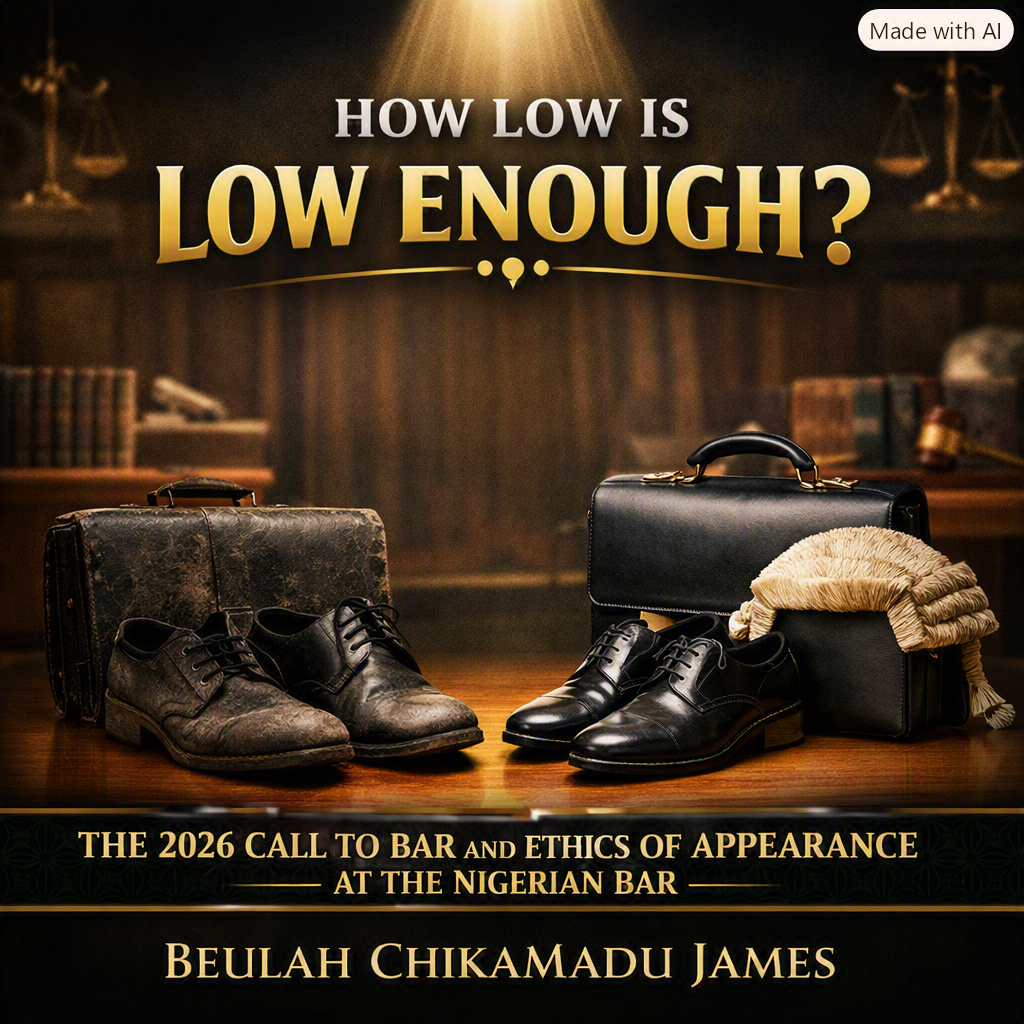
The rationale is evidently decorum. But my experience caused me to ask a deceptively simple question: how low is low enough?
If a Nigerian man has bathed, wears freshly washed and ironed prescribed clothing, maintains clean natural nails, has no distracting accessories and presents his naturally textured African hair neatly trimmed and combed, what precisely makes him insufficiently sober?
More importantly, if he already has what would ordinarily be regarded as a neat low haircut, what additional ethical value is achieved by requiring him to cut it lower?
This is not an argument against dress codes. Nor is it an accusation that requiring neat hair is inherently discriminatory. Professional institutions must be able to maintain standards.
It is instead an argument for proportionality.
The ethical objective should be professional dignity, not uniformity merely for uniformity’s sake.
There is something worth interrogating when, in Nigeria, an African preparing to enter what has been described as the largest Bar in Africa can present his natural hair neatly and conservatively yet still feel that its natural texture or volume must be further suppressed before his appearance sufficiently reflects professional sobriety.
Our profession inherited many of its traditions from England: the wig, gown, forms of address, courtroom etiquette and other conventions. Tradition has value. It gives the profession continuity and institutional identity.
But tradition should not become immune from examination simply because it is tradition.
The history of the Nigerian Bar itself demonstrates that professional conventions can evolve. Following the controversy surrounding Amasa Firdaus Abdulsalam, who was denied participation in a 2017 Call to Bar ceremony after refusing to remove her hijab, the Body of Benchers subsequently permitted the wearing of the hijab for law-related activities.³
The profession survived that accommodation. Its dignity did not disappear.
That episode demonstrates an important point: professional dignity and individual identity are not necessarily enemies.
Can a Sober Profession Celebrate?
Another lesson from the ceremony concerned the use of legal regalia.
Immediately before the July 2026 Call, the Council of Legal Education issued a warning against candidates wearing wigs and gowns and presenting themselves on social media as qualified legal practitioners before they had formally been called. The Council specifically criticised candidates who described themselves prematurely as “Barristers and Solicitors of the Supreme Court” or appended “Esquire” to their names. It warned that such conduct could attract disciplinary consequences and affect eligibility for Call to Bar.⁴
The Council was on firmer ethical ground here.
Aspirants may understandably be excited, but professional status cannot be assumed before it is legally acquired. Section 22 of the Legal Practitioners Act regulates unauthorised practice, while Rule 45 RPC regulates the use of lawyers’ robes outside court. The distinction between almost a lawyer and a lawyer may appear small to an excited aspirant, but ethically and legally it is fundamental.
I also learned at the ceremony that “Barrister” is not properly used as a prefix or title before a lawyer’s name. The Chairman of the Body of Benchers, Chief Albert Akpomudje, SAN, CFR, cautioned the newly admitted lawyers against the practice during the July 2026 ceremony.⁵
These lessons reinforced something important: the wig and gown are not costumes.
They represent an office and a professional responsibility.
But a related question remains.
Should sobriety eliminate celebration?
Consider what precedes Call to Bar.
For some, the journey began with unsuccessful attempts to obtain admission to study law. Others experienced financial difficulties, family challenges or personal circumstances that interrupted their education. Some completed university but could not immediately proceed to the Nigerian Law School. Others watched their classmates proceed while they waited.
Then comes Law School itself.
Candidates study under enormous pressure knowing that an adverse result can delay the dream they have pursued for years. Some watch friends return for resit examinations. Others eventually arrive at Call after a journey considerably longer and more difficult than they imagined when they first opened a law textbook.
Then, finally, their names appear among those eligible to be called.
After all that, must celebrating in a red suit or brown corporate attire for a private photograph necessarily be inconsistent with belonging to a “sober profession”?
I do not think the answer should automatically be yes.
There is an important distinction between wearing legal regalia improperly or falsely representing oneself as a lawyer, on the one hand, and celebrating an extraordinary personal achievement after legitimately attaining it, on the other.
Sobriety should describe the lawyer’s character and professional conduct, not the complete absence of colour or joy from the lawyer’s life.
What the Ceremony Taught Me
My greatest lesson from the 2026 Call to Bar was that becoming a lawyer is a fragile and intentional journey.
An aspirant may spend years preparing for the profession and still discover, at the final threshold, that seemingly minor conduct can have professional consequences. The Council of Legal Education’s July 2026 warning made this particularly clear: premature use of professional regalia or representations of professional status could jeopardise eligibility for Call.⁶
I therefore learned that legal ethics does not begin with one’s first client.
It does not begin with one’s first court appearance.
It begins with understanding that admission into the profession carries an identity that must neither be falsely assumed nor carelessly represented.
I also witnessed the extraordinary importance the profession attaches to hierarchy and institutional respect. The Chairman’s presence and leave were formally recognised before steps were taken. To an outsider, some of these practices may appear ceremonial. To someone preparing for the profession, they communicate something deeper: the Bar expects humility.
But the same profession that teaches us respect for rules also teaches us to interrogate them.
Lawyers ask: What is the rule? What is its purpose? Is its application consistent with that purpose? Does the distinction being drawn have a rational basis? Does the result advance justice?
We should be capable of respectfully asking the same questions about our professional traditions.
The Bar I Hope to Join
I do not want a Nigerian Bar without standards.
I want to join a profession that takes appearance seriously, insists on discipline, protects the significance of its regalia and demands exemplary conduct from those privileged to practise law.
But I equally hope to join a profession confident enough in its identity to distinguish dignity from rigidity, sobriety from sameness, and professional regulation from unnecessary restriction.
Natural African hair that is clean, trimmed, combed and professionally maintained is not inherently rebellious. Clean natural nails are not unprofessional. Tasteful celebration is not necessarily incompatible with professional restraint.
The real ethical inquiry should always return to the purpose behind the standard: does the conduct genuinely undermine the dignity of the profession?
If it does, the profession is justified in regulating it.
If it does not, perhaps the tradition deserves another look.
As I watched 6,009 people cross the threshold into the Nigerian Bar that week, I saw something of my future in them. Their Call reminded me that the privilege of becoming a lawyer carries responsibilities long before one’s first brief is received.
It also reminded me of the kind of lawyer I hope to become: one who respects the traditions of the profession without believing that respect requires intellectual silence.
The legal profession is, indeed, a sober profession. But sobriety should ultimately mean integrity, discipline, restraint, responsibility and service to justice. It should never become a convenient synonym for unnecessary rigidity.
I left the Body of Benchers Complex that Thursday with admiration, questions and hope.
And perhaps that is precisely what legal education should produce.
For me, the ceremony was more than an externship experience. It felt like an affirmation and a promise yet to be fulfilled.
I am next in turn to be called to the Bar.
And when that day comes, I hope to enter a profession whose traditions I understand, whose dignity I will protect, and whose continued development I will never be afraid to thoughtfully question.
References
- The Guardian, ‘Guardian Law Editor Onyekwere, Mokuolu, among 6,009 new lawyers called to Bar’ (9 July 2026).
- Body of Benchers, Guidelines for the November 2025 Call to Bar Ceremony, as reported by BarristerNG, 19 November 2025.
- The Guardian, ‘Body of Benchers okays use of hijab for law activities’ (22 June 2018).
- Council of Legal Education, Public Notice on unauthorised use of barristers’ regalia by candidates awaiting Call to Bar, as reported by Punch, 7 July 2026.
- Rules of Professional Conduct for Legal Practitioners 2023, rr 1, 36 and 45; Legal Practitioners Act, Cap L11 LFN 2004, s 22.
- Council of Legal Education, Public Notice, July 2026.
Author’s Bio
CHIKAMADU BEULAH JAMES is a Nigerian Law School student and emerging legal writer with interests in legal ethics, professional responsibility, human rights and the development of the Nigerian legal profession. Her writing explores the relationship between law, professional culture and contemporary social realities.The views expressed in this article are the author’s personal reflections.