
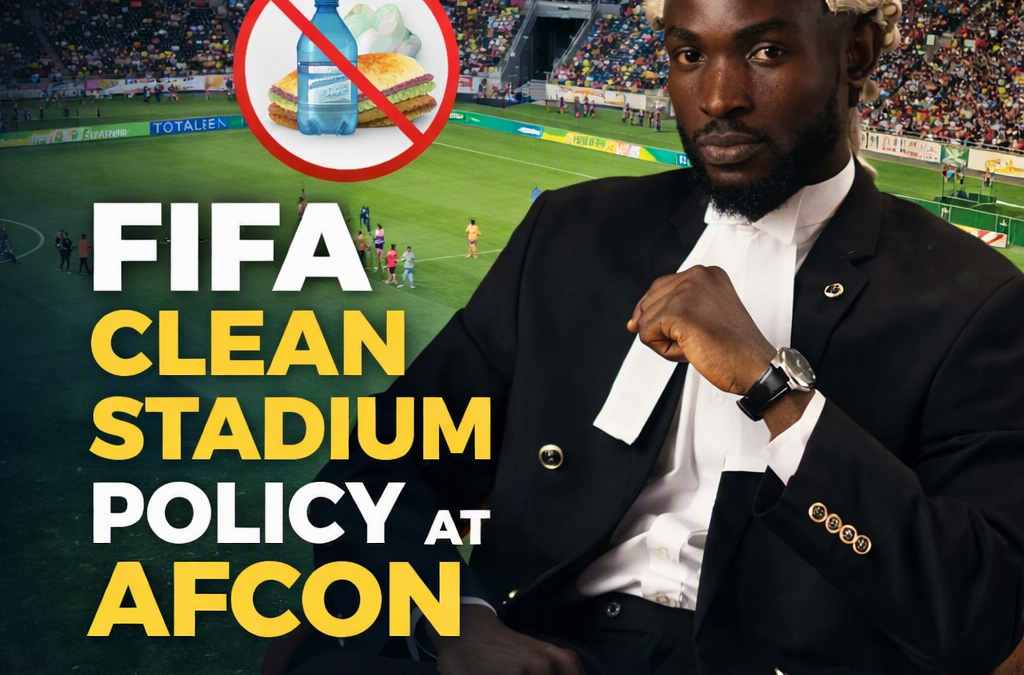
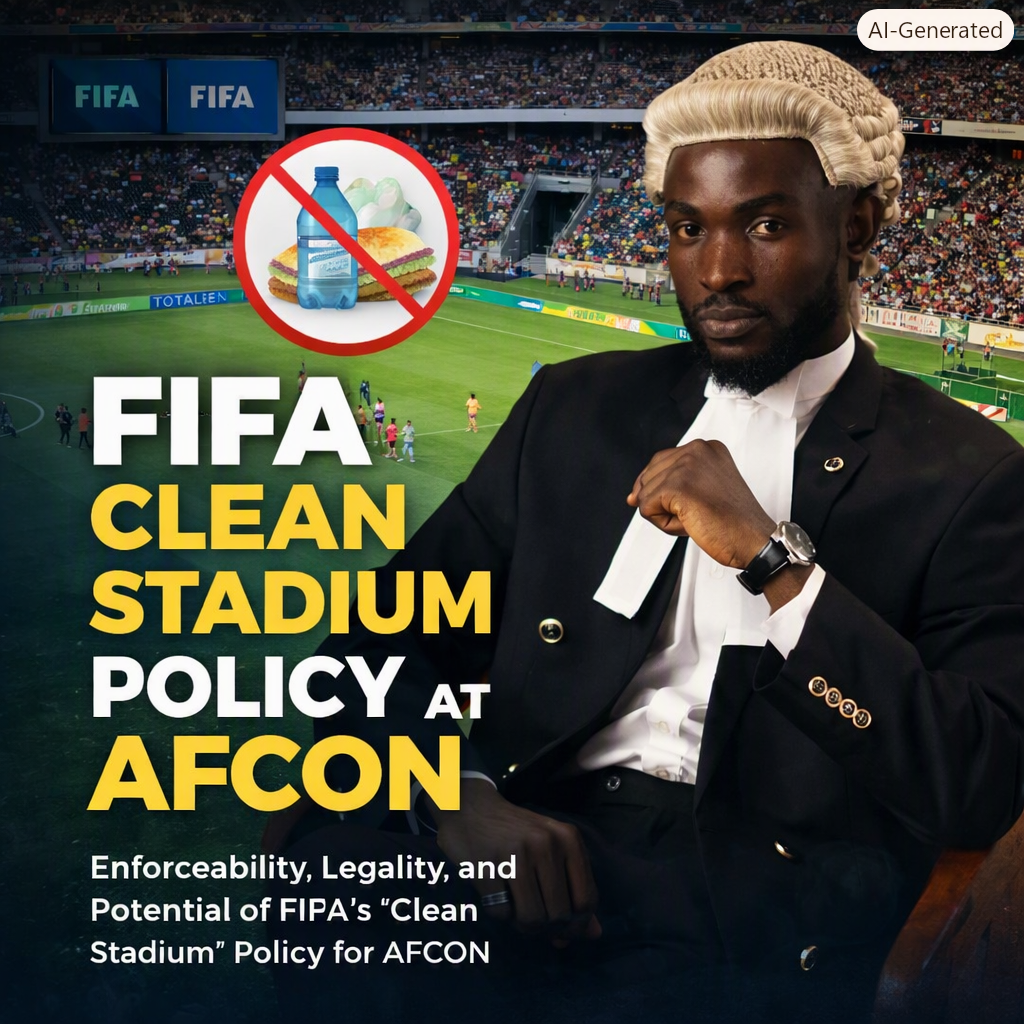
Introduction:
When the whistle blows to kick off a high-stakes Africa Cup of Nations (AFCON) match, millions of eyes are glued to the screen. The broadcast is pristine, the pitch-side digital boards flash in perfect harmony, and the stadium looks like a sleek, unified theater of global sport defined adverts, clear-cut brand promotions and silenced marketing noise. To the average fan, spectator and sportsman, it is simply world-class entertainment and a different angle to marketing—and it is.. But to the legal practitioner who has developed interests in the optics of global sports and the sports marketer, that visual perfection is the result of a rigorous, aggressive, and often invisible operational framework: the “Clean Stadium” policy.
Pioneered by FIFA and particularly more emphasized in the just concluded 2026 World Cup, the clean stadium directive requires a host venue to temporarily shed its commercial identity for the duration of a tournament. All corporate naming rights are suspended, fixated and semi-permanent local advertisements are physically covered or in some cases, digitally masked, and a strict “Clean Zone” radius is enforced outside the venues of the tournaments to lock out unauthorized brands.
For the Confederation of African Football (CAF), adopting and implementing this level of commercial discipline could just be a step toward transforming AFCON into a premium global asset that commands top-tier sponsorship. However, beyond the glossy finish of the idea lies a rather harsh economic paradox: while the governing body makes money directly from the streams of revenue that are opened up by the enforcement of the said policy, the host nation ultimately bears the immediate operational costs and legal friction of “Cleaning” the venues. For African football to truly modernize, we must look beyond the glossy broadcast and ask a critical question: is the clean stadium policy a sustainable blueprint for the growth of the continent’s commercial revenue, or is it simply a commercial burden that would strain the local ecosystem?
The Legal & Commercial Anatomy of a “Clean Slate”
To understand this operational friction, one must first understand its mechanics. A “Clean Stadium” is not merely aesthetically influenced; it is a strict contractual mandate embedded within the Host Country Agreement. Under the operational lens of The Clean Stadium Policy, when a nation wins the bid to host a tournament like AFCON, it signs up to deliver a blank canvas to the governing body. This operational scrubbing happens across three primary frontiers:
First, there is the suspension of naming rights. Naming Rights describes a financial and marketing arrangement where an entity purchases the exclusive right to name a physical venue, event, or asset for a specific period. If a match is played at a venue with a corporate-sponsored name, that identity is completely erased for the duration of the tournament. The venue reverts to a neutral, geographic designation.
Second is the physical and digital de-branding of the stadium arena. Every piece of permanent signage; logos, brand IDs painted on the concrete stands, to advertisements affixed to scoreboards or corporate suites belonging to a non-sponsor brands must be physically covered with neutral drapes, wrapped in tournament graphics, or digitally masked during live broadcasts.
Further, the restriction extends far beyond the main bowl into what is considered the “Clean Zone” perimeter. Governing bodies typically mandate a radius of 1km to 2km surrounding the stadium where all commercial activity is heavily regulated. Within the clean zone, local billboards are bought out or blanked, and unauthorized shadow marketing from non-sponsors are strictly prohibited.
From an Intellectual Property standpoint, this absolute control is the core essence of sports partnership. Global partners pay huge amounts not just for exposure, but more for the exclusivity that comes with it. If a multinational telecommunications giant, say MTN for example, is the official sponsor of AFCON, its investment is severely jeopardized if a rival local Telecommunications Company’s logo is permanently visible in, across and around the stadium. A clean stadium guarantees that the official sponsors own 100% of the optics, enhancing the benefits that are attendant to being an exclusive partner.
The Host Nation Paradox: Paying for Someone Else’s Party?
Undisputably, the idea behind a clean stadium/zone is sound, especially when considered from the commercial stand point. The operational and financial reality for the host country, however, exposes a stark imbalance. For one, the primary structural conflict lies in a simple distribution problem: CAF would, ideally, retain the revenues accruing from international broadcasts and partnerships from its primary global sponsors such as TotalEnergies, Visa and Orange. Conversely, the host government is left to completely fund the machinery required to ‘clean’ the designated arenas and ensure maximum compliance within the surrounding perimeters.
From the African focal point, this entire arrangement raises vital questions and triggers a plethora of legal, social, economic and contractual disputes:
1. The Domestic Contractual Hassle:
Unlike many Western and European stadiums and sport arenas owned by multi-billion-dollar private clubs, individuals and corporate organizations, a majority of elite stadiums in Africa are owned publicly by state or national governments. Many of these stadiums are commemorative of significant personalities, historic events and cultural heritage. To ensure ease of, maintenance the management of these stadiums often enter into multi-year advertising and naming-rights contracts with local businesses, companies, and corporate giants—typically domestic telecommunications companies, regional banks, or national breweries.
Where a Host Country Agreement forces a city to temporarily “de-brand” a venue, the ripple effect is that such pre-existing arrangement is actively breached. If a local brand has paid for exclusive rights to have its logo permanently painted onto a stadium’s concrete stands for ten years, covering it up for a month creates immediate legal and economic exposure. The host government can be left facing severe financial penalties or prolonged litigation from angry domestic corporate partners who are locked out of the biggest sporting events on their own soil.
2. The Backlash Against “Corporate Colonialism”
The enforcement of a strict 1km to 2km “Clean Zone” around venues would easily incite significant friction among members of the public. The local brands being aggressively blacked out are often the same companies that heavily invest in and bankroll domestic leagues, youth academies, and grassroots football year-in year-out when global cameras are nowhere to be found.
When a governing body enters into an agreement that demands the immediate removal of these entities to protect the commercial interests of foreign multinationals, it easily constructs a damaging narrative of corporate extraction. It can appear as though lucrative global brands are monopolizing the economic windfall of an African tournament while actively pushing aside the homegrown businesses that sustain the continent’s footballing ecosystem when no one is watching.
3. The Displacement of Micro-Economies
From a socio-economic angle, the rigid enforcement of clean zones carries immediate consequences for small and medium-sized enterprises (SMEs). An AFCON tournament represents a generational economic lifeline for informal street traders, local food vendors, independent artisans, and ticket-holders looking to sell refreshments near the gates. A strict enforcement of the Clean Stadium and Clean Zone policy would jeopardize the efforts that most African countries are now putting in place to support and build strong SMEs.
Because a Clean Zone policy regulation strictly protects the pouring and selling rights of official tournament partners, informal local commerce would inadvertently become outlawed or aggressively policed outside the turnstiles. Instead of circulating tournament wealth directly into the pockets of lower-income entrepreneurs within the host city, the immediate stadium perimeter becomes an exclusive commercial enclave for international partners—effectively locking out the local community from the immediate financial harvest of a global event hosted on their home soil.
The Strategic ROI: Why Host Nations Agree to the Hit
Considering the operational hassles, potential legal issues and the inevitable backlash from locals, why should any African host government willingly accept these terms? The answer lies in looking past immediate match-day ticket receipts and evaluating the long-game, macroeconomic return on investment (ROI). Essentially, delaying gratification.
For a host nation, bearing the costs of a clean stadium policy functions like a strategic investment. The nation wouldn’t buying a short-term cash payout; it is buying three critical long-term assets:
1. Global Credibility and the “Audition Asset”
In modern sports diplomacy, administrative discipline is a currency. Executing a tournament that strictly honors international Intellectual Property laws and commercial exclusivity signals to global sporting bodies that such a country possesses the institutional maturity to host top-tier sporting events.
Morocco’s recent commercial and operational precision across major CAF and FIFA tournaments stands as a prime example—it effectively served as a live, multi-year audition to prove to FIFA that it was ready to co-host the 2030 FIFA World Cup. Accepting the upfront costs of a clean stadium policy certifies a host nation as a low-risk, high-capability partner for future multi-billion-dollar global sporting events.
2. Modernizing Domestic Infrastructure
Enforcing a clean stadium policy forces host nations to fundamentally upgrade their sports infrastructure. Because static, painted billboards cannot be easily “turned off” for a tournament without looking unsightly or damaged, host cities are pressured to replace outdated structures with modern, digital LED perimeter boards and high-definition electronic screen systems.
When the cameras roll out and the tournament ends, that high-tech infrastructure remains behind. A shadow of what would have been an innovative development that can always be revived when the need arises. Domestic clubs and national sports leagues inherit a modernized commercial arena, allowing local teams to sell dynamic, multi-tier digital ad space for decades to come.
3. Signaling Rule of Law to Foreign Direct Investors
Global corporations do not invest solely based on stadium sizes; they invest based on regulatory and operational capability and reliability. When an African country demonstrates that its legal system can aggressively enforce IP rights, clear out ambush marketing, and protect commercial exclusivity in the face of local pressure, it sends a powerful signal to multinational investors outside of sport, proving that the nation respects contracts, welcomes development and is capable of protecting foreign investments—a crucial reassurance for cross-border capital, tech hubs, and infrastructure development.
Conclusion: Charting a “Hybrid” Path for African Football
For the Africa Cup of Nations to continue its trajectory toward becoming a premier global sporting event alongside the UEFA Euros and the FIFA World Cup, commercial foresight and discipline is non-negotiable. Exclusivity drives sponsorship value, sponsorship value funds tournament prize money, and prize money elevates the entire quality of the sport across the continent. In this light, the clean stadium policy is a considerably and potentially effective mechanism for CAF’s global growth.
However, applying European or North American commercial templates blindly across Africa runs the risk of depleting local heritages, instigating local participants and fracturing the national ecosystems that sustain the game all year-round. A host government cannot be expected to repeatedly burn its relationships with domestic sponsors and SMEs without a more balanced and promising framework.
The future of AFCON lies in developing a uniquely African “hybrid” model. CAF and host nations must begin negotiating nuanced Host Country Agreements that carve out specific, regulated spaces for local commerce—perhaps through designated “Domestic Sponsor Fan Zones” or secondary sponsorship tiers within the broader tournament city. This way, the Football Association protects local industries, guarantees the growth of SMEs and exposes the host nation to bigger opportunities and global validation. By protecting the pristine integrity of the broadcast bowl for global partners while thoughtfully integrating local businesses into the broader event experience, African football can protect its lucrative global assets without sacrificing the local roots that give the tournament its unmatched passion and identity.
 A. E. Alabi, Esq. is an intellectual property lawyer with a keen interest in the intersection of law, innovation, technology, and the creative economy. His work focuses on helping businesses and creators identify, protect, and maximize the value of their intellectual assets while contributing to conversations on emerging issues in copyright, trademarks, artificial intelligence, and regulatory policy. He is passionate about developing practical legal frameworks that strengthen innovation and position intellectual property as a driver of economic growth.