
Beyond the Ballot Box: Why Voters’ Privacy Will Define Trust in Nigeria’s 2027 Election
As Nigeria prepares for the 2027 General Elections, public discourse has understandably focused on electoral credibility, transparency, security, logistics, and the ability of institutions to deliver a free and fair election. However, one issue that demands equal attention is the protection of voters’ personal data and its impact on public trust. In today’s digital age, elections are no longer driven solely by physical processes. From voter registration and biometric identification to digital databases and electronic communication platforms, technology has become deeply embedded in electoral administration. While these innovations provide opportunities for greater efficiency and transparency, they also create significant risks if personal information collected from citizens is not adequately protected.
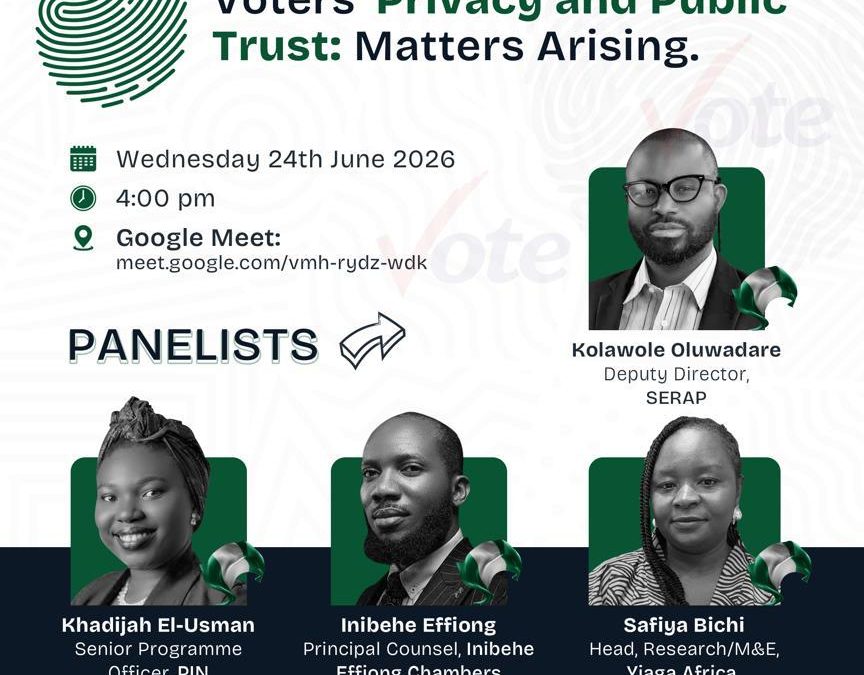
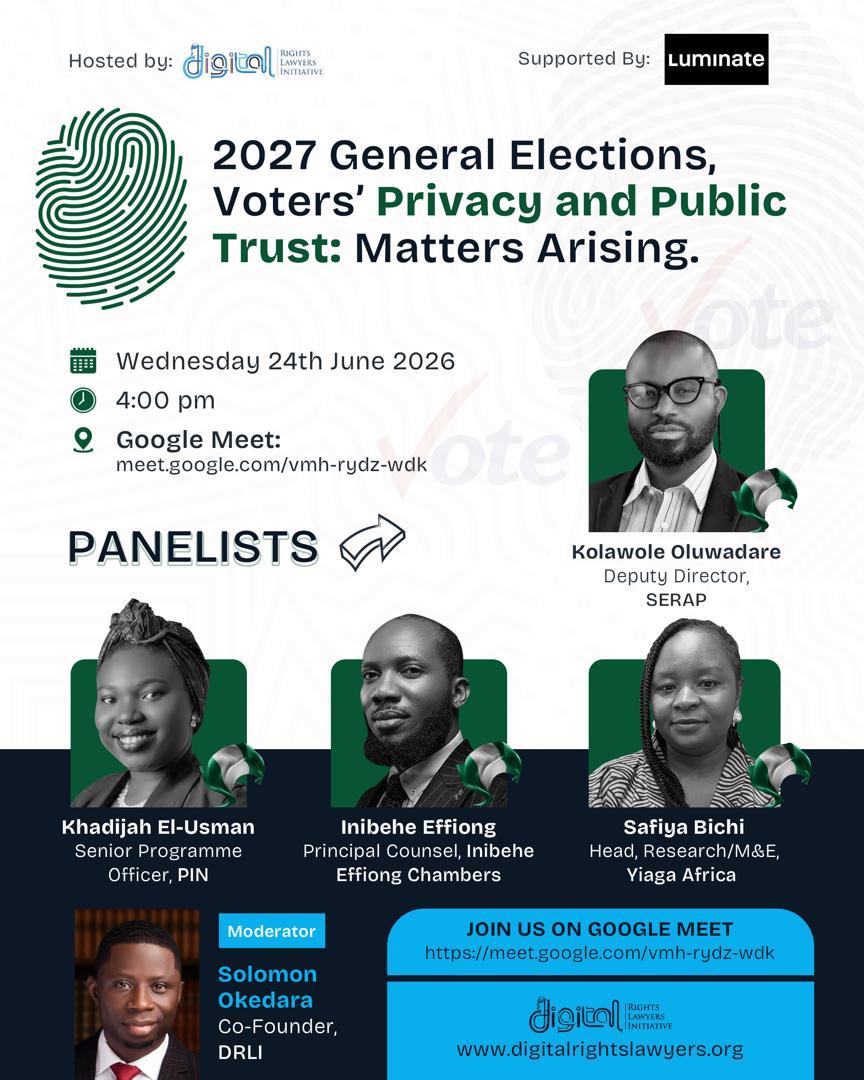
The question before Nigeria ahead of 2027 is therefore not only whether citizens can exercise their right to vote freely, but also whether they can trust that the personal information they rovide as part of the electoral process will be handled responsibly, securely, and lawfully. It is against this backdrop that the Digital Rights Lawyers Initiative (DRLI) will convene a national conversation titled “2027 General Elections, Voters’ Privacy and Public Trust: Matters Arising” on Wednesday, 24 June 2026. The event will provide a platform for stakeholders across Nigeria’s electoral and digital rights ecosystem to examine the challenges, opportunities, and responsibilities associated with protecting voters’ personal information ahead of the next general elections.
The virtual convening will bring together key industry experts. It will feature leading voices in human rights, accountability, and digital governance, including Kolawole Oluwadare, Deputy Director of the Socio-Economic Rights and Accountability Project (SERAP); Khadijah El-Usman, Senior Programs Officer at Paradigm Initiative; Inibehe Effiong, Principal of Inibehe Effiong Chambers; and the Head of Research and Monitoring & Evaluation at Yiaga Africa. The conversation will be moderated by Solomon Okedara, Co-Founder of DRLI.
Speaking on the importance of the convening, Solomon Okedara, Co-Founder of DRLI, stressed that voters’ privacy must become a central component of Nigeria’s electoral preparedness.
“Public trust in elections is not built only at polling stations. It is also built through confidence that citizens’ personal information is collected, processed, and protected responsibly. When citizens provide their data to institutions, they must have assurance that such information will not be exposed, exploited, or used in ways that undermine their rights.”
Okedara also highlighted the enormous responsibility placed on INEC as one of Nigeria’s largest data controllers.
“INEC is one of the largest data controllers in Nigeria, processing the personal information of over 93 million registered voters. The scale and sensitivity of this data create significant responsibilities and risks. Any compromise of electoral data could have consequences beyond individual privacy; it could affect public confidence in the credibility of the electoral process.”
The concerns surrounding electoral data protection extend beyond cybersecurity. They raise important questions about accountability, transparency, oversight, and institutional responsibility. As Nigeria continues to adopt technology-driven approaches to electoral management, there must be clear safeguards to ensure that digital transformation strengthens democracy rather than creates new vulnerabilities. As Nigeria approaches another significant electoral milestone, one message is clear, the integrity of the 2027 General Elections will depend not only on the ballot cast by millions of Nigerians but also on the protection of the personal information that enables their participation.
The programme is proudly supported by Luminate, whose partnership with DRLI reflects a shared commitment to advancing digital rights, strengthening democratic accountability, and promoting responsible technology governance in Nigeria.