
He Claimed He Deserved a Second Class Upper Degree, but His University Insisted on a Second Class Lower. So, Who Was Right? The Case Of Victor v. F.U.T.A. (2026) 8 NWLR (Pt. 2044) 33.
It is said that every case tells a story, but this case did not merely tell a story; rather, it engraved courage and demonstrated that one should be unflinchingly audacious in the pursuit of a legitimate claim. The facts concern something many students can easily relate to: examination results, and the hero in this judicial drama is a layman named Mr. Adebayo A. Victor, who remained extremely adamant for years in pursuit of getting the Second Class Lower Division grade awarded to him by his university upgraded to a Second Class Upper Division, which he believed was what he truly merited.
Interestingly, throughout these years, this layman pursued the case by himself all the way to the Supreme Court. This is indeed something to marvel at.
Nota bene, when we say “layman” in legal profession, we simply mean a person who is not a legal practitioner. No disrespect whatsoever is intended. Rather, the expression is used to emphasize the ingenuity, determination, and resilience of Victor who, despite not being a lawyer, pursued the case personally from the Federal High Court up to the Supreme Court. That being said, let us now properly dwell on the surrounding circumstances that midwifed this case.
Victor was the cross-appellant in this appeal. The Federal University of Technology, Akure (FUTA) was the 1st cross-respondent, while its Registrar, by virtue of his office, was also made a party as the 2nd cross-respondent. He (Victor) was a student of Mechanical Engineering at FUTA. In 2007, he graduated and was awarded a Second Class Lower Division degree. However, he was dissatisfied and was convinced that the degree classification awarded to him did not reflect his actual academic performance. According to him, some of his examination scores were incorrectly recorded. Consequently, he applied for the remarking of several courses, namely: MEE 202, MEE 301, MEE 302, MEE 305, MEE 307, MEE 308, MEE 309, MEE 311, MEE 312, and MEE 352.
Why was he so persistent?
Because he believed that if those scripts were properly re-marked, he would emerge not as a Second Class Lower graduate but as a Second Class Upper graduate. For about four years, from 2007 to 2011, he tried to exhaust every available avenue within the university system. Unfortunately, the university refused to yield to his request for the remarking.
At that point, Victor did what many students would probably never contemplate doing. He approached the Federal High Court, Lagos Division, in August 2011 seeking several reliefs, including orders directing the university to remark his scripts through independent assessors, issue his correct transcript and certificate, and compensate him for the losses he had suffered.
I believe many of us would just take fate and would never think of taking the above bold step, or do you believe you have Victor’s courage and could do the same? Anyway, hold the answer to yourself.
When the matter came up for hearing at the Federal High Court, it was dismissed on 16 January 2013 on the ground that it was statute-barred.
The university would, of course, be naturally satisfied, while Victor was not and did not believe that was the end, as many litigants would do. He appealed. And certainly, the Court of Appeal reasoned with Victor that his case was not statute-barred. Consequently, on 29 November 2013, the court set aside the decision of the trial court and ordered a retrial.
Looks like Victor had won the first round, right?
Indeed, he had. Now they were back to square one at the trial court.
Fresh pleadings were filed, issues were joined, and the matter proceeded to full trial. At the conclusion of the trial, the Federal High Court delivered judgment on 28 September 2017. The court found substantially in favour of Victor, though not on all his reliefs. Specifically, the court granted reliefs 5 and 7. The first was an order directing the cross-respondents to remark Victor’s examination scripts through external examiners. The second was an order directing the respondents to issue a final result and transcript reflecting his actual performance in the examinations. The court further awarded the sum of ₦500,000 (Five Hundred Thousand Naira) as general damages in favour of Victor. Victor had won. The university had lost. Naturally, one would expect the university to simply comply and move on.
It did not. The university refused to obey the orders immediately. Instead, dissatisfied with the judgment, it appealed to the Court of Appeal.
Victor too was not entirely happy.
He was like, after all these years, after all the stress, after all the emotional torture, after losing opportunities, after being denied the benefit of his actual academic standing, is this really what I am taking home? Surely this cannot be all.
And think about it. According to Victor, he had lost the opportunity of benefiting from the Nigeria Agip Exploration 2010/2011 International Postgraduate Scholarship Award, a fully funded Master’s programme in the United Kingdom. He had suffered emotional distress, repeated travels, financial hardship, and several years of uncertainty. So, I do not blame him at all.Consequently, he filed a cross-appeal.
For those unfamiliar with the concept, a cross-appeal is simply an appeal filed by a party who won the case but is nevertheless dissatisfied with some aspect of the judgment. Such a party is called a cross-appellant. In other words, both parties were unhappy, albeit for different reasons.
At the Court of Appeal, Lagos Division, one of the major issues concerned several documents that had been rejected by the trial court. The Court of Appeal held that Exhibits A, B, E, and O were private documents and not public documents as the trial court had held. Therefore, they did not require certification before being admitted in evidence.
The court also frowned at the conduct of the university in withholding documents after being served with a notice to produce. According to the court, a party cannot sit on documents, refuse to produce them, and later turn around to complain that the opposing party failed to prove facts contained in those very documents.
That would certainly be unfair, wouldn’t it? After all, that conduct of the University is not in due fidelity to the expectations of the provisions of the evidence Act specifically section 167 of the Evidence Act, as Indeed, “Justice is not a fencing game where one party seeks to outsmart the other.” ~Per Ogunwumiju JSC
Eventually, the Court of Appeal dismissed the university’s appeal in its entirety. Victor’s cross-appeal succeeded only in part. The court awarded him ₦50,000 (Fifty thousand) as costs at the trial court and ₦200,000(Two hundred thousand) as costs of the cross-appeal.
The university was unhappy.
Victor was equally unhappy.
Looks like both parties had become regular customers of the appellate courts, right?
And so they both found their way to the Supreme Court. However, before the hearing of the appeal, the university had a change of heart. Following the intervention of the Supreme Court, the university withdrew its appeal, which was subsequently dismissed on 21 June 2022.
Why did the university withdraw?
The answer is not far-fetched.
By then, the university had eventually complied with the orders directing the remarking of Victor’s scripts.
And guess what?
Victor was right.
The remarking exercise upgraded his degree classification from Second Class Lower Division to Second Class Upper Division.
The university subsequently issued his transcript and degree certificate accordingly. In fact, during one of the subsequent proceedings before the Supreme Court, Victor’s certificate and transcript were physically handed over to him in open court.
The university also informed the court that it had paid the earlier awards of ₦500,000 (Five hundred thousand) damages and ₦250,000 (Two-fifty) costs.
What then remained?
Of course, Victor’s cross-appeal challenging the inadequacy of the damages and costs awarded by the lower courts. He therefore urged the Supreme Court to award substantially higher compensation considering the years of hardship, emotional distress, lost opportunities, and frustration he had endured.
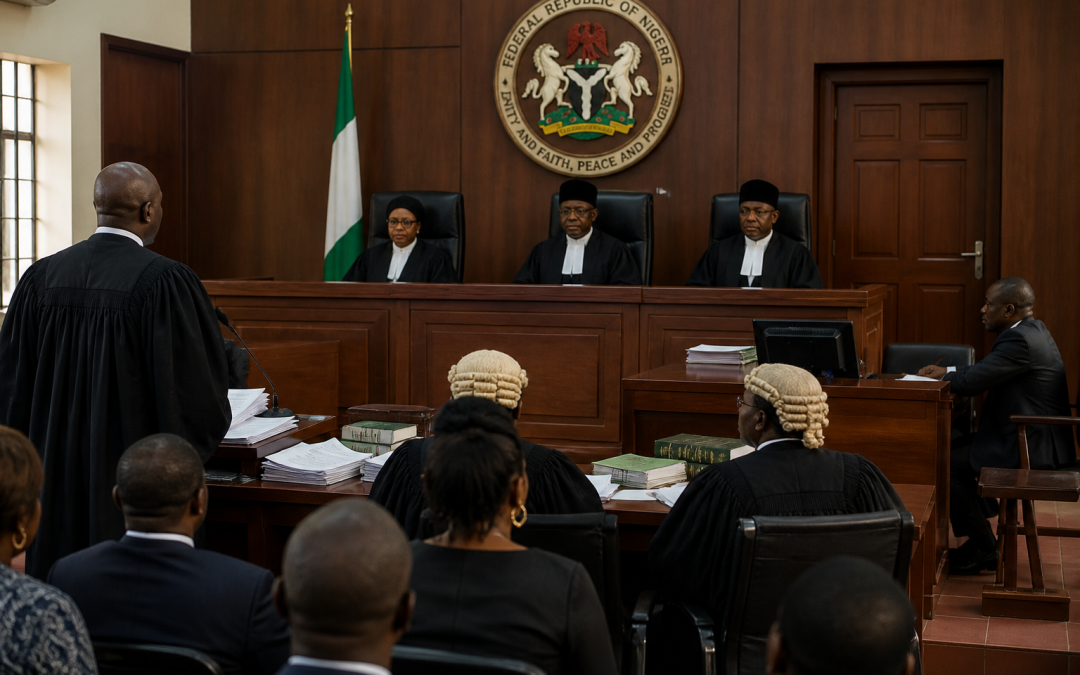
The appeal eventually came before a panel of five eminent Justices of the Supreme Court, namely John Inyang Okoro, JSC, who presided; Helen Moronkeji Ogunwumiju, JSC, who delivered the lead judgment; Obande Festus Ogbuinya, JSC; Stephen Jonah Adah, JSC; and Abubakar Sadiq Umar, JSC.
Supreme Court per Ogunwumiju, JSC, in unraveling the wool beclouding the judicial posers made reference to several authorities and lucidly explained that universities possess the exclusive authority to award degrees and determine academic standards. Courts generally do not interfere with academic judgments.
However, does that mean a university can act however it pleases?
The answer is in the negative. A university owes a duty of care to its students. For years, Victor persistently complained about his results and requested a review. Yet the university refused to investigate the complaint or re-mark the scripts until compelled by court orders.
It is the view of the Supreme Court that, that conduct amounted to a breach of the duty of care owed to Victor as its student.
The Court Per Ogunwumiju, further emphasized again that though academic decisions are generally not subject to judicial interference, where there is evidence of negligence, bias, procedural unfairness, or a breach of duty of care, the courts will not fold their arms. My Lord added, the duty of care owed by a university extends to academic, administrative, and welfare matters. A university must provide fair assessment procedures, competent supervision, transparent academic processes, proper handling of complaints, fair decision-making, and reasonable administrative support. My Lord reasoned that, in the instant case, the respondents abandoned that duty of care.
Supreme Court, then proceeded to explain the law relating to damages.
As we know, where a person successfully establishes a tortious wrong against another, he is generally entitled to general damages. Such damages flow naturally from the wrong and need not be specifically pleaded or strictly proved.
On the other hand, special damages, such as specific financial losses, medical expenses, or lost earnings, must be strictly proved.
The Court therefore agreed that, Victor had not sufficiently proved some of his claims for special damages, particularly the claim relating to lost earnings.
However, the Court held that there was no doubt that he suffered emotional distress, hardship, inconvenience, frustration, and loss of opportunities as a direct consequence of the university’s conduct.
The Court further observed that by 2017, when the trial court awarded ₦500,000 as general damages, Victor had already endured approximately ten years of suffering. According to the Supreme Court, that amount was simply too small in the circumstances.
The award could not be merely symbolic; it had to be genuinely compensatory. Consequently, the Supreme Court reviewed the award upward.
And not by a small margin.
The sum of ₦500,000 (Five hundred thousand) awarded by the lower courts was set aside and replaced with ₦18,000,000 (Eighteen Million Naira) as general damages for breach of duty of care and the emotional and physical stress suffered by Victor.
Furthermore, the court awarded ₦2,000,000( Two Million Naira)as costs of litigation, recognizing that although Victor was a layman, he had personally prosecuted the matter through the entire hierarchy of courts and incurred substantial expenses in so doing. In effect, Victor left the litigation with two major victories.
First, he obtained the Second Class Upper Division degree he had been pursuing since 2007.
Second, he obtained a total monetary award of ₦20,000,000.(Twenty Million Naira).
Please pause for a moment and clap for Victor.
He truly deserves it.
Remember, this was not a lawyer. This was a man who personally prosecuted his case from the Federal High Court to the Court of Appeal and ultimately to the Supreme Court.
He challenged a university. He lost at the first stage. He appealed. He returned for a retrial. He won. He defended that victory through the Court of Appeal. He defended it again before the Supreme Court. And in the end, he was vindicated.
All the other Justices adopted the reasoning of Ogunwumiju, JSC, and abided by the award hook, line, and sinker, having disclosed not an atom ounce of hostility that could warrant their reprobation of the lead judgment.
Lastly, it is gleanable from the above legal anatomy that although universities possess academic autonomy and retain the exclusive right to award degrees, they must nevertheless act fairly in dealing with students. Certain class of degrees should not be awarded according to whims and caprices. Those who genuinely work for them should receive them, as students’ futures may depend on the decisions made by university authorities.
This decision therefore serves as a reminder that while courts may be reluctant to interfere in academic matters, they will not hesitate to intervene where a university abandons its duty of care and subjects a student to avoidable hardship.
And perhaps that is the greatest lesson from this case. I will say no more, believing I have passed the message.
_______________________________________________________________
Isah Bala Garba is a Level 400 student of Common and Islamic Law of Bayero University, Kano,(SABUK). He has authored numerous legal articles and analyzed many cases in clear, plain language. He can be reached for comments or corrections on: LinkedIn: https://www.linkedin.com/in/isah-bala-garba-301983276 isahbalagarba05@gmail.com or on 08100129131.