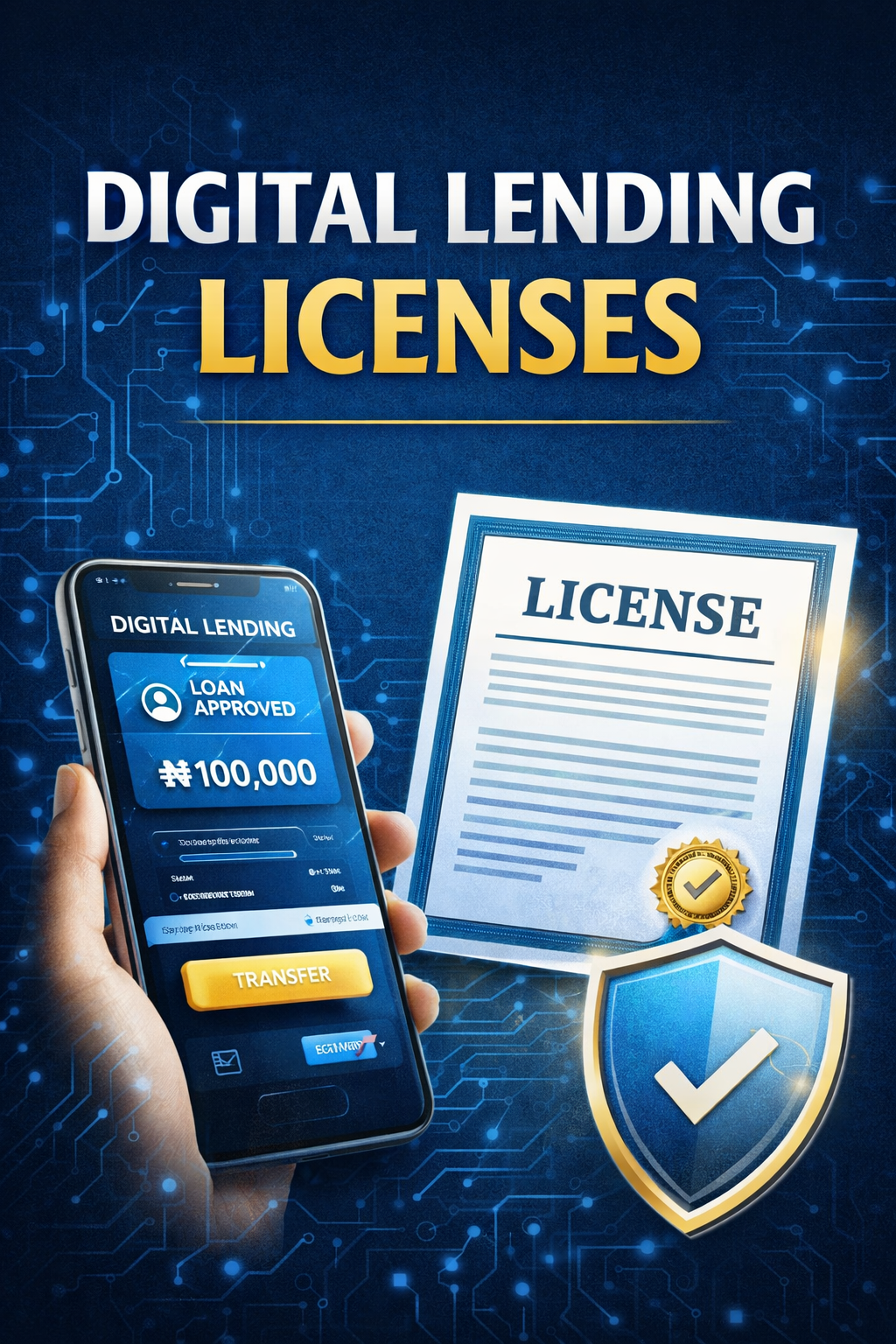
Introduction:- Digital consumer lending has come a long way in Nigeria, starting from the introduction of Microfinance Banks (MFBs) and lending companies that evolved from one-man money-lenders that in some cases acted as glorified loan sharks, to money lending licenses governed by state governments, to loan apps operated by Nigerian & foreign-owned companies that sometimes engaged in business practices that by today’s standards, were quite very unfair and downright illegal.
Digital consumer lending is simply the business of licensed money-lenders rendering consumer lending services through the means of digital loan web or mobile applications, which means that in order to own a digital lending platform (be it a website, USSD service, or app) operational in Nigeria, 2-tier licensing must be obtained, first from the relevant state government in the state where the intending money-lender is located, and then from the Federal Competition & Consumer Protection Commission (FCCPC), the government agency tasked with granting licensing to digital lenders in Nigeria.
This article will be looking at:-
1). Eligibility requirements for licensing as digital lenders in Nigeria.
2). The cost & time implications of securing digital money-lending licensing in Nigeria.
3). The validity of digital lender licensing grants in Nigeria.
4). The relevant FCCPC regulatory requirements where lending partnerships are formed for the purpose of rendering consumer lending services in Nigeria.
What is the major regulatory provision governing FCCPC licensing of digital lenders in Nigeria?
The FCCPC exercises its jurisdiction over the licensing and regulation of digital lenders in Nigeria through its DEON (Digital, Electronic, Online/Non-Traditional) Consumer Lending Regulations.
Which companies are eligible to secure digital lending licensing from the FCCPC?
FCCPC licensing is open to companies that have already obtained money-lending licenses from their respective state governments as other non-lending financial service companies (like Mobile Money Operators or MMOs)licensed by other sector regulators like the Central Bank of Nigeria (CBN).
What is the minimum share capital requirement for a money-lending company?
Money-lending companies in Nigeria carry a minimum share capital requirement of 20 (Twenty) Million Naira & 100 (One Hundred) Million Naira for foreign-owned companies .
What are the requirements for obtaining a money-lending license from states like Lagos State for instance?
Getting a money-lending license in Lagos State requires the following:-
a). A registered limited liability company with at least 2(Two) directors and relevant incorporation documents.
b). Proof of a physical office in Lagos State.
c). Police clearance for the 2 directors.
d). 3- year Tax Clearance Certificates (TCCs) or proof of tax registration of the company if it’s newly registered & its 2 directors.
e). A reference letter from the applicant company’s bank.
f). Filled & submitted magistrate forms B & C.
g). An application fee of 25,000.00 Naira.
h). A registration/license fee of 200,000.00 Naira.
i). A license renewal fee of 100,000.00 Naira.
How long does it take to get the state money-lending license?
If all documentation is complete, at least 4-8 weeks.
How long does FCCPC digital lending licensing take?
It takes a period of 30(Thirty) days from the submission of all required documentation.
What are the requirements for FCCPC digital lending licensing?
a). Filled & submitted application forms 001 & 002.
b). An application fee of 100 (One Hundred) Thousand Naira.
c). An approval/licensing fee of 1(One) Million Naira. This enables a digital lending company to have 2 separate digital loan apps.
d). An additional approval fee of 500 (Five Hundred) Thousand Naira for an extra third lending app proposed by a licensed money-lending company. A licensed digital lender is allowed to have a maximum of 5 (Five) loan apps.
e). A consumer lending services agreement where the licensed money-lending company is in a partnership with a technology services company to provide the tech infrastructure needed to provide the consumer lending services.
f). A completed data regulations compliance audit report from a Data Protection Compliance Organization (DPCO) as well as Nigerian Data Protection Commission (NDPC) clearance. These will arrest that a digital lending company will not engage in DEON violations that include accessing the call log & & reaching contacts of loan defaulters.
g). The company’s compliance policies – Anti-Money Laundering(AML/CFT) , Privacy policy, KYC Policy, & Dispute Resolution policy among others.
What is the validity period of FCCPC licensing for digital lenders in Nigeria?
FCCPC licensing for digital lenders lasts till the 31st of December of the third year from the date of FCCPC licensing approval and is required to be renewed not later than the 31st of March of the subsequent year.
FCCPC licensing renewal requires a renewal fee of 500(Five Hundred)Thousand Naira.
Can FCCPC licensing be revoked and on what grounds?
Yes, FCCPC licensing for digital lenders can be revoked on the grounds of:-
a). Violating the DEON regulations or any relevant regulation of the FCCPC.
b). Discovery of misleading or false information supplied to the FCCPC by a money-lending company at the licensing stage.
c). A money-lender acting against the interests of its consumers/platform end-users.
Revocation of licensing can also come with imposition of fines on a defaulting money-lending company.
Emmanuel Ifeanyi Ogbuka, Esq, a lawyer and legal consultant, writes from Lagos,Nigeria.
Phone:- +2347011261897
Email:- ogbukalegal@outlook.com
***PLEASE NOTE****:- This article is strictly for informative purposes and neither constitutes legal advice nor prohibited advertising as prescribed by the Rules Of Professional Conduct For Legal Practitioners In Nigeria.